
Angleton’s Slip: Did the National Security State
Assassinate Jack Dunlap?
Part 4: Later Revelations (Continued)
By James Nicita
[Ed. Note: numbering continues from Part 3]
2. Dunlap Accesses the CIA and Angleton's Counter-Intelligenece Staff
Part 2 of this series detailed Fox’s first two reasons for suspecting Dunlap: his “no-inspection” status as the chauffeur for successive NSA chiefs of staff; and his expanded access to NSA material through his “pilfering ring” with various corrupt NSA officials.
Fox had a third reason, and this one triggers an earthquake that destabilizes the facade of the Dunlap story constructed by the public accounts described in Part 1 and the available agency record described in Part 2.
All of the source material for those installments limited Dunlap’s access to the confines of the NSA’s Fort Meade headquarters. According to Fox, however, Dunlap emerged from the confines of Fort Meade and entered the inner sanctum of the CIA; and, in fact, right into Angleton’s counterintelligence staff. Based on Fox’s disclosure, Edward Epstein wrote:
[I]n 1961, [Dunlap] was given responsibility by the [NSA] chief of staff for shuttling secret data back and forth between Fort Meade and the CIA counterintelligence officers on Angleton's staff who were cleared on a "need to know" basis to see these interceptions. This afforded Dunlap the opportunity to ascertain — and feed back to his Soviet case officers — the questions that CIA counterintelligence was asking about data intercepted from the Soviet Union. He could have, up until 1963, delivered what Fox called the "methodology" for this intelligence.[1]
According to Epstein, military intelligence never determined the foregoing as fact, due to Dunlap’s “apparent” suicide.[2]
Fox also alerted Epstein to the Carroll Report, the internal NSA review of the Dunlap matter mentioned in Part 2. After Epstein obtained the partial report through a Freedom of Information Act request, Epstein returned to Angleton to discuss it. Angleton did not dispute that Dunlap had interacted with his staff, and provided Epstein with a separate confirmation regarding Dunlap’s role in providing the Soviets with feedback:
After reading through the Carroll Report, which he had obviously seen before, Angleton said glumly, “The real tragedy was that Dunlap was never debriefed."
...Angleton did not want to talk about Dunlap's contacts with his staff, saying, "That was not the problem." He explained that in 1962, when Dunlap was carting NSA data by the trunkload to his Soviet case officers, the NSA was involved in the installation and security arrangements for the CIA's new central computer. This system not only connected up the CIA's own archives but provided electronic channels to safely transmit data to outside agencies in the intelligence community. Since this computer was a prime target of Soviet intelligence, Angleton feared that Dunlap might have given away the computer's safeguard design. If so, the Soviets could "breach the computer from the outside" and monitor, step by step, the way the CIA "conceived of an intelligence problem." He then suggested that in the late 1960s his counterintelligence staff and the Office of Security developed incontrovertible evidence that such a "breach" of the computer system had indeed occurred. The Soviets thus had their feedback.[3] [Emphasis added.]
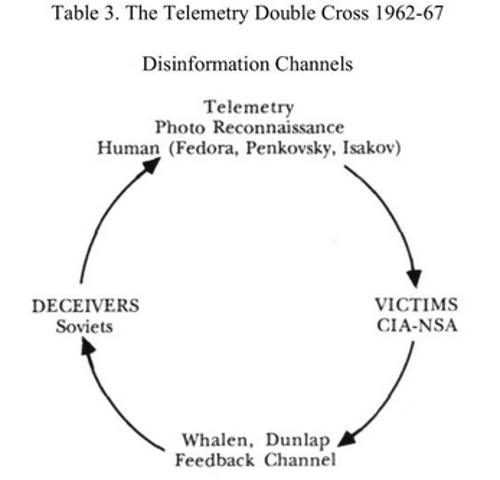
Epstein illustrated the “telemetry double-cross” feedback loop:[4]
3. Later Revelations Supporting Epstein and Fox
Whatever one thinks of Epstein’s “telemetry double-cross” theory, after Deception’s 1989 publication, subsequent revelations and disclosures yielded additional evidence supporting Epstein’s reporting and Fox’s background information that Dunlap’s spying for the Soviets involved matters of telemetry and Soviet missile tests.
Part 1 cited Michael Patterson, the proprietor of a website containing biographies of veterans buried at Arlington National Cemetery, including Jack Dunlap. Dunlap’s biography, posted in 2006, includes significant information regarding his career and alleged suicide. However, virtually all of it is unattributed.
Certainly, Patterson’s ties with and service to the vast veteran constituency to which he was connected lend some credibility to the information these veterans provided for his biographies. On the other hand, reliance on such anonymous or undocumented information must remain qualified until it can be confirmed through named individuals or specific documentation.
Patterson posted information that during Dunlap’s tour of duty at the Army Security Agency facility in Sinop, Turkey, Dunlap had a particular interest in telemetry. “After gaining access to operations Dunlap was especially interested in the telemetry signals, etc. and on several occasions was seen going into the restricted COMCEN area, but because he was a Senior NCO, no one challenged him and it will NEVER be known if he secreted or photographed anything therein.”
Recall from Part 3 that the Soviets had found their own telemetry data on a downed American transport plane in 1957; and that the U.S. was monitoring Soviet telemetry signals from ground stations in Turkey, Iran, and Pakistan. The Turkish station was likely Sinop, and 1957 is the year Dunlap commenced his tour of duty there. Thus it is possible that the Hungarian spy Alex Klopstock initially recruited Dunlap in Sinop specifically to access telemetry data.
In addition, Part 2 discussed the CIA’s “Dunlap resume,” declassified in 2003, summarizing the Dunlap case. The resume included a description of a document highlighting both Dunlap’s and his Soviet handler’s interest in U.S. capacity to obtain intelligence on Soviet missile testing:
On September 10, 1963, Mrs. Dunlap turned over to the FBI a National Security Agency Top Secret Codeword document which she said she had found among her personal effects. The document was dated August 17, 1962 and was entitled “Use of Radioprinter Scrambler on Soviet Missile Test Ranges.” The document outlined the National Security Agency’s capability for analyzing this Soviet communications system as a means for establishing (a) that a Soviet missile test is under way (b) the approximate time that a Soviet missile launch may or did occur (c) whether the Soviet missile firing was a successful launch and (d) whether in-flight failure occurred.[5]
4. Was Angleton Running Dunlap as a Deception Agent?
Dunlap’s interaction with Angleton’s counterintelligence staff at CIA headquarters was not part of the initial public story described in Part 1, nor the available contemporary agency record described in Part 2; it did not emerge until a quarter century after the fact.
It is not mentioned in the CIA’s “Dunlap resume,” which, as mentioned in Part 2, was possibly “Attachment A” to the President’s Intelligence Advisory Board’s (PFIAB) report on the Dunlap matter intended for President Kennedy and dated the day of the latter’s assassination.
It is not mentioned in any of the released pages of PFIAB minutes for 1963-1964. Indeed, as mentioned in Part 2, when Angleton’s deputy Raymond Rocca appeared before the PFIAB on September 12, 1963, he spoke only in hypothetical terms about what the CIA security system would do to uncover a “Dunlap,” as if Dunlap had never gained access to the CIA; when in fact Rocca was precisely the type of officer on Angleton’s counterintelligence staff that Fox suggested had been interacting with Dunlap.
In their respective Church Committee testimonies, neither Angleton nor Harvey mentions Dunlap’s access to the CIA. Likewise, Rocca in his brief testimony regarding Dunlap to the House Select Committee on Assassinations.[6]
If the CIA was indeed withholding from the PFIAB information on Dunlap’s access to Angleton’s staff, the PFIAB becomes an eerie precursor to the Warren Commission. The CIA withheld information from the PFIAB regarding its contacts with Dunlap, just as months later it would withhold information from the Warren Commission regarding its extensive contacts with Lee Harvey Oswald.
As the decades passed, it emerged that among the CIA’s reasons for withholding information on Oswald was that it was making operational use of Oswald on multiple levels.
Was the CIA also making operational use of Dunlap?
Part 2 mentioned this quote from “The Importance and Future of Espionage” by Frederick Hitz: "By 1959, Angleton had unearthed Jack Dunlap as a mole in the NSA who had reached high-level 'no-inspection' clearances."[7]
As it turns out, Frederick Hitz was the former inspector general of the CIA.[8] Even though he does not provide a specific documentary citation for his quote, it is a fair assumption that he based his quote on documentation to which he had first-hand access. Thus his statement is as credible as is the statement by Colonel Fox – the former head of counterintelligence for the DIA – that Dunlap interacted with Angleton’s staff at the CIA beginning in 1961.
Taking these two credible statements together, the hypothetical possibility arises that Angleton was in fact running Dunlap as a disinformation agent against the Soviets. The process could have begun in 1959 within the NSA when Angleton first discovered Dunlap’s no-inspection “mole” status, and continued beginning in 1961 with Dunlap’s additional access into the CIA. Under such a scenario, Dunlap would have believed the information he was extracting from the NSA and Angleton’s staff was valuable intelligence, when in fact much or most of what he obtained was the disinformation that Angleton wanted transmitted to the Soviets.
The scenario might explain the security question regarding Dunlap’s CIA access. If the CIA, like the NSA, accepted Dunlap’s ASA security clearance that did not include a polygraph, it may well have been because the CIA already knew full well that Dunlap was a mole, and was allowing him access specifically to make use of him in its deception operation.
If the Dunlap-as-deception-agent scenario has validity, it flips the script on Epstein. His feedback loop graphic above gets turned upside down; Dunlap is instead at the top of the loop as the deception agent, and some other mole within the Soviet Union is the feedback agent.
And, to return to Rexroth’s quote [28] mentioned in Part 3, did Angleton deceive both Epstein and history about the scenario? If valid, it illuminates how brilliantly Angleton did so.
B. Dunlap and the CIA’s Division D
If Dunlap gained access to Angleton’s CIA counterintelligence staff, it is not a great stretch to think that he also gained access to Harvey’s Division D. As noted in Part 1, Angleton controlled access to Division D.
Michael Patterson, Dunlap’s Arlington Cemetery biographer mentioned above, posted an anonymous assertion that Dunlap did in fact have access to Division D:
There were many reasons why it would have been inconvenient to arrest and Jack Dunlap [sic]. For one, he was a liaison with “Staff D” in the CIA, and could expose areas of CIA-NSA cooperation in domestic interceptions that could be deemed illegal. [9]
We confront the same problem with this quote as we did above with the Patterson quote regarding Dunlap’s interest in telemetry while at Sinop: this “Staff D” quote from Dunlap’s bio is not substantiated by documentation or by an authoritative source like Colonel Fox or Frederick Hitz.
One way to gauge the credibility of Patterson’s anonymous source might be to confirm independently the other principal assertions in the “Staff D” quote: 1) that there were areas of CIA-NSA cooperation in domestic interceptions, during the period of Dunlap’s spying, that could be deemed illegal; and 2) that there was concern whether the arrest and public trial of Dunlap would reveal sensitive matters regarding illegal government activities. If these elements hold true, then we might be more inclined to accept as well the source’s assertion that Dunlap was an NSA liaison to “Staff D.”
1. CIA-NSA Cooperation in Potentially Illegal Domestic Interceptions.
This writer has not found reference to any potentially illegal Division D-specific domestic interceptions that occurred up through the time of Dunlap’s spying; The CIA’s “Family Jewels” disclosures documented one post-Dunlap episode from the early 1970s.[10] Of course, there could have been potentially illegal Division D interceptions, including up through Dunlap’s time, that have never been disclosed.
Broader CIA-NSA cooperation on potentially illegal interceptions includes the following programs discussed by the Church Committee, and this list is very likely not exhaustive:
- NSA Watch Lists. The Church Committee described this surveillance program of international phone calls of U.S. citizens on American soil. Both the CIA and the FBI provided names to the NSA for its “watch lists.” The program began as early as 1960, which would include Dunlap’s period of spying. The program was named MINARET in 1969.[11]
- Operation SHAMROCK. Through this program, the NSA obtained copies of millions of telegraphs sent to and from the U.S. The CIA formally began providing the NSA cover support for SHAMROCK in 1966. However, since SHAMROCK originated in 1945, it is likely that the CIA cooperated with the NSA on this program long before 1966. In addition, throughout the program’s existence, the NSA shared the information it acquired through SHAMROCK with the CIA, the FBI, the Secret Service, the Justice Department, or the Defense Department.[12]
- NSA Files on American Citizens. From 1952 until 1974, the NSA maintained files on American citizens that contained information the agency had acquired through its intercept programs, and from intelligence reports from other agencies like the CIA. The NSA allowed CIA agents unsupervised access to the files for 13 years.[13]
One illegal domestic spying operation deserves mention, even though it does not specifically involve either Division D or the NSA: “Project Mockingbird,” the CIA’s illegal wiretapping of journalists Robert S. Allen and Paul Scott, disclosed as part of the CIA’s “Family Jewels,” and mentioned briefly in Part 1. The Kennedy Administration directed the CIA’s Office of Security to wiretap these two journalists in order to discover their sources of classified national security information. The wiretaps took place between March 12, 1963, and June 15, 1963,[14] and therefore partially overlap Dunlap’s period of access within NSA, and possibly still with CIA, up until his denial of access in May 1963. Needless to say, if his CIA access had somehow allowed Dunlap to get wind of “Project Mockingbird,” it certainly would have been cause for concern that a public trial of or defection by Dunlap might reveal an operation coordinated by Attorney General Robert F. Kennedy himself.
2. National security concerns regarding public trials in cases of espionage.
Other sources support the other element of Patterson’s “Staff D” quote concerning Dunlap, namely, the concern that a public trial might reveal sensitive national security secrets, including potentially illegal domestic surveillance.
In a 1990 article, Captain M.E. Bowman cited this fear of disclosure as real:
The general concern is the potential for public, even world-wide exposure of national security information. At times, this concern stems from constitutional legal requirements for disclosure of evidence – in this case classified information – for exposure of that information in a courtroom.[15]
Therefore, Bowman argued, Americans had not often seen espionage cases in the glare of the public spotlight. That changed in 1980 with the successful prosecution of William Kampiles, who had sold a satellite technical manual to the Soviets. “The entire process was a success with respect to the protection of national security information.” That same year, Congress enacted the Classified Information Procedures Act, which gave the government additional tools to protect national security information during espionage trials.[16]
In Dunlap’s time, however, the original concerns regarding the disclosure of national security information still prevailed, including with such intelligence officials as Angleton. Epstein wrote in Deception,
As Angleton explained, the counterintelligence technique employed by the CIA when it discovers a potential "turned" employee is not to arrest him and hold a public trial, since the KGB will learn their agent is compromised, as well as other valuable clues from the legal proceedings. The KGB will then have the opportunity to replace a known agent with an unknown one. The alternative that is followed, according to Angleton, is to quietly transfer suspects from highly sensitive compartments.[17]
Perhaps Angleton applied this alternative to Dunlap, and engineered the latter’s Army transfer order overseas and out of NSA in January of 1963, as related in the “Dunlap resume.” This transfer order led Dunlap to seek civilian NSA employment, take and fail the required polygraph, and face NSA suspicions; all of this resulting in his reassignment to a non-sensitive area of Fort Meade.
3. The Division D Cookie Jar.
Thus there is some level of contextual support for the statement in Michael Patterson’s Dunlap bio that Dunlap was the NSA liaison with Division D, and for the resulting possibility that he gained physical access to Division D. However, without documentary evidence or an authoritative individual to substantiate the assertion, it would be inadvisable to rely on it.[18]
That said, it is tempting to speculate on the consequences of Dunlap somehow breaching the impenetrable security of Division D and accessing for his Soviet clients the nation’s darkest and deadliest national security secrets of his era. The following are samples of the cookies in the Division D cookie jar:
- ZRRIFLE global criminal burglary, break-ins, and kidnapping to steal communications and signals intelligence codes.[19]
- ZRRIFLE assassination plots, including mafia-connected efforts against Fidel Castro.[20]
- Domestic surveillance and wiretapping against embassies, diplomats, and foreign citizens.[21]
- Global wiretapping of foreign targets.[22]
- The Division D “gold mine” of information resulting from the monitoring of all radio transmissions from Cuba by the team of 50-100 Cuban exile AMOTS overseen by Harvey deputy David Morales.[23]
- Division D’s direction-finding station in Miami, the division’s work in airborne direction-finding capability for high-frequency transmissions, and how this process related to the OXCART prototype spyplane to replace the U-2.[24]
- Monitoring and wiretapping of the Cuban and Soviet consulates in Mexico City in early 1963, prior to the visit by Oswald.[25]
- Division D’s “Green List,” a listing of names appearing in communications intelligence (COMINT) from anywhere in the world.[26]
If Dunlap had gained knowledge of the ZRRIFLE assassination program, that alone would likely have proven the strongest motivation to assassinate him prior to a public trial or a feared defection.
IV. Summary
To return to the title of this series: did the national security state assassinate Jack Dunlap?
The four installments suggest that there were a number of possible motives:
- The Kennedy Administration wanted to avoid a sensational trial that might upset Senate ratification of the Limited Test Ban Treaty.
- Dunlap’s co-conspirators in the NSA “pilfering ring” wanted to silence him to keep him from acting as a witness in their own prosecution.
- National security officials determined that Dunlap had betrayed Oleg Penkovsky, and panicked by the defection of Victor Norris Hamilton to Moscow, decided to assassinate Dunlap before he could similarly defect and disclose information to the Soviets that would endanger the lives of other American assets.
- National security officials feared that Dunlap could have exposed, in a public trial or after defecting, areas of CIA-NSA cooperation in domestic interceptions that could be deemed illegal.
- Dunlap accessed Angleton’s CIA counterintelligence staff and obtained extremely sensitive intelligence; therefore, Angleton directed the assassination of Dunlap to avoid disclosure of these secrets in a public trial or via Dunlap’s defection to the Soviet Union.
- Dunlap accessed Harvey’s Division D and obtained extremely sensitive intelligence; therefore, Harvey directed the assassination of Dunlap to avoid disclosure of these secrets in a public trial or via Dunlap’s defection to the Soviet Union.
Much remains to be learned in order for historians to resolve the question. Part 2’s catalog of still-undisclosed agency records could help clarify the matter. So could documents pertaining to Dunlap’s access to Angleton’s counterintelligence staff and potential access to Harvey’s Division D.
Finally, all of the records discussed in this series are, without question, JFK assassination records, whether one considers specific records like the still-hidden portions of the minutes of the President’s Foreign Intelligence Advisory Board on November 21-22, 1963, or, more broadly the numerous records regarding the Dunlap spy scandal that have already been released pursuant to the JFK Records Act definition: “a record that is related to the assassination of President John F. Kennedy.” Americans have a “compelling interest in the prompt public disclosure of [such] assassination records for historical and governmental purposes and for the purpose of fully informing the American people about the history surrounding the assassination of President John F. Kennedy.”[27]
___________
Read Part 1. Click here to read part 1.
___________
-
Epstein, Deception, pp. 174-175. If Dunlap’s CIA assignment occurred prior to July 1, 1961, the assigning chief of staff would have been Thomas Watlington, who retired on that date. Obituary, Thomas Morgan Watlington, Assembly, July-August, 1997, (West Point, NY, West Point Association of Graduates, United States Military Academy), p. 166. If after that date, the author is unaware of the identity of the subsequent chief of staff, as he noted in Part 2.
-
Epstein, Deception, p. 175.
-
Id., pp. 175-176.
-
Id., p. 176. Note the Table’s inclusion of Oleg Penkovsky as a disinformation agent. Earlier in Deception, Angleton made the case to Epstein that Penkovsky was a disinformation agent for the Soviet Union, even if an unwitting one, during the Cuban Missile Crisis. Id., pp. 79-80.
-
Central Intelligence Agency, “Sergeant Jack Dunlap, U. S. Army,” November 22, 1963, pp. 3-4, approved for release August 8, 2003, CIA-RDP83-01022R000100010002-1.
It is possible that this document served as at least one of the bases for the October 1963 report, mentioned in Part 1, by columnists Robert S. Allen and Paul Scott, to the effect that Dunlap had provided to the Soviets extensive details on U.S. capability to detect nuclear tests and missile launchings, and exhaustive data on Russian nuclear blasts and space shots. Allen, Robert S. and Scott, Paul, “Data Given Reds On US Nuclear Detection Blind Spots?” Tallahassee Democrat (Tallahassee, FL), October 17, 1963, p. 3.
-
House Select Committee on Assassinations, Interview of Raymond G. Rocca, July 17, 1978, JFK Assassination System, U.S. National Archives, Record No. 180-10110-10004, pp. 218-219.
-
Hitz, Frederick P., "The Importance and Future of Espionage," in Johnson, Loch K., Strategic Intelligence, Vol. 2. (Westport, CT., Praeger Security International, 2007), p. 82.
-
C-SPAN’s Book-TV, “After Words: Frederick Hitz, ‘Why Spy?’ interviewed by Peter Earnest, May 13, 2009.
-
Presumably the intended text was “arrest and try Jack Dunlap,” i.e., put Dunlap on trial for espionage.
The CIA first established Division D as “Staff D.” According to a declassified CIA document, the name change occurred approximately 1955-1966.
-
Central Intelligence Agency, Memorandum from Chief, Division D to Deputy Director of Operations, Subject: “Potentially Embarrassing Activities Conducted by Division D,” May 7, 1973, National Security Archive.
-
Senate Select Committee to Study Governmental Operations with Respect to Intelligence Activities (“Church Committee”), Supplementary Detailed Staff Reports on Intelligence Activities and the Rights of Americans, Book III, (Washington, D.C, U.S. Government Printing Office, 1976), pp. 739, 743.
-
Church Committee, Book III, pp. 738, 775; Robarge, David, “US Intelligence, Domestic Surveillance, and the Time of Troubles,” Central Intelligence Agency, Studies in Intelligence, Vol. 68, No. 2 (June 2024), p. 4.
-
Church Committee, Book III, p. 778.
-
Central Intelligence Agency, “Project Mockingbird,” included in “Family Jewels” disclosure, p. 21, National Security Archive.
-
Bowman, Captain M.E., “Prosecuiting Spies: An Uneasy Alliance of Security, Ethics and Law,” National Military Intelligence Foundation, American Intelligence Journal, Vol. 11, No. 2 (Spring 1990), p. 29.
-
Id.
-
Epstein, Deception, p. 186.
-
The author has found one book that cites Patterson’s Dunlap bio. In his 2008 book Brothers in Arms: The Kennedys, the Castros, and the Politics of Murder (New York, Bloomsbury USA, 2008), writer Gus Russo, without scrutinizing or evaluating the anonymous “Staff D” assertion in Patterson’s Dunlap bio, states flatly that Dunlap “[s]old Staff D files to KGB” (p. vii); and later states incorrectly that Dunlap worked “in the NSA’s traffic-analysis division, otherwise known as Staff D” (p. 267).
-
Stockton, Flawed Patriot, pp. 146-147.
-
Id., pp. 147-189.
-
Hancock, Nexus, p. 63.
-
Id.
-
Reid, Jack, “Signals Intelligence Pt. 1: New JFK Files Reveal 1963 ZRRIFLE Cover Operation,” JFK Facts, June 22, 2026.
-
Reid, Jack, “From the JFK Files: How the CIA Channeled Money to William Harvey’s Assassination Program,” JFK Facts, December 9, 2025.
-
Simpich, BIll, State Secret: Wiretapping in Mexico City, Double Agents, and the Framing of Lee Oswald, “Chapter 4: Mexico City Intrigue – The World of Surveillance,” Mary Ferrell Foundation.
-
Id.
-
PUBLIC LAW 102-526—OCT. 26, 1992 106 STAT. 3443, Section 3(2) and (10).
-
Rexroth, Philip D., “Deception Unbounded: Counterintelligence and the Angleton Worldview,” American Intelligence Journal, Vol 35, No. 2 (National Military Intelligence Foundation, 2018) p. 48. (Citations omitted.)


