
A Lie Too Big to Fail: The Second Edition
In this author’s view, Lisa Pease is the foremost researcher/writer on the assassination of Senator Robert Kennedy. That event occurred in Los Angeles at the Ambassador Hotel, almost immediately after the senator had been announced as the winner of the 1968 California primary. This was a crucial win for RFK. It essentially knocked out of the running his chief primary rival, Senator Eugene McCarthy. The only man left standing between RFK and the Democratic nomination was Vice President Hubert Humphrey.
The problem with Humphrey was that he was tied to an unpopular president in Lyndon Johnson. Which is why Johnson had abdicated. LBJ had almost lost to McCarthy in New Hampshire. And according to Jules Witcover’s book 85 Days, his internal polls said he was going to lose in the state of Wisconsin. Therefore, Johnson made his epochal announcement on March 31, 1968: he would not run. That declaration rocked the MSM and the country. But it was one thing to almost lose to Eugene McCarthy. Johnson simply could not stomach losing to his hated rival, Bobby Kennedy.
As Witcover’s book shows, Bobby Kennedy had planned on entering the primaries before the New Hampshire result. But he did not want that announcement to impact the voting there. So he delayed it until afterwards. Then, 2 weeks later, LBJ withdrew.
The problem for Humphrey was not just Johnson’s poor ratings. The elephant in the room was the Tet Offensive. At a famous meeting in the Oval Office, Bobby Kennedy had tried to tell Johnson what he thought was the best way out of Vietnam. Johnson should declare a cease-fire, set up a provisional government, and then hold elections. Johnson said that would never happen. Because he knew from his commanding general, William Westmoreland, who had told him victory would arrive in a few months. At that time, all of LBJ’s dovish enemies would be vanquished. Robert Kennedy left the meeting in shock and disbelief. He knew there was no such victory in sight. (James Douglass, Martyrs to the Unspeakable, p. 410).
Tet showed he was right. But Humphrey was stuck with both Johnson and Vietnam. RFK was not. The Democratic Party did not want more of either Vietnam or Johnson. So Bobby most likely would have won the nomination. And Richard Nixon would not have been able to use those issues against him. Plus, RFK would have had the ghost image of his martyred brother behind him. In other words, America would have been saved from six years of Nixon, the increased bombing in Indochina, the invasions of Laos and Cambodia, Watergate, the ultimate resignations of Nixon and Agnew, the lasting image of the last helicopter on the American Embassy leaving Saigon, etc.
After Johnson stepped out of the race, Martin Luther King would now be able to do what he wanted to do. His advisers had requested that he endorse McCarthy. He said he wanted to wait for Bobby to declare his intention since he thought he would make an outstanding president. (The Promise and the Dream by David Margolick, p. 295) King never got to make that endorsement. He was murdered in Memphis on April 4, 1968. RFK was campaigning in Indiana when he got the news. His advisors told him that he probably should not speak that night because of the risk of violence. RFK said, “I’m going to 17th and Broadway. I’m going to go there and that’s it.” (ibid, p. 340) The first thing he asked was for the crowd to lower his campaign signs. He then went on and gave the crowd the news that King had been assassinated. A great stillness ensued. He urged them not to take up arms, not to burn down buildings. That would lead to greater polarization. That was not what America needed at this time. He said King had dedicated his life to justice and love between human beings. And he had died in that effort. And that is what we should all try to emulate at this moment. It was probably one of the greatest speeches of his life to that unsuspecting crowd in Indianapolis. As a result, Indianapolis was one of the very few big cities that did not go up in flames.
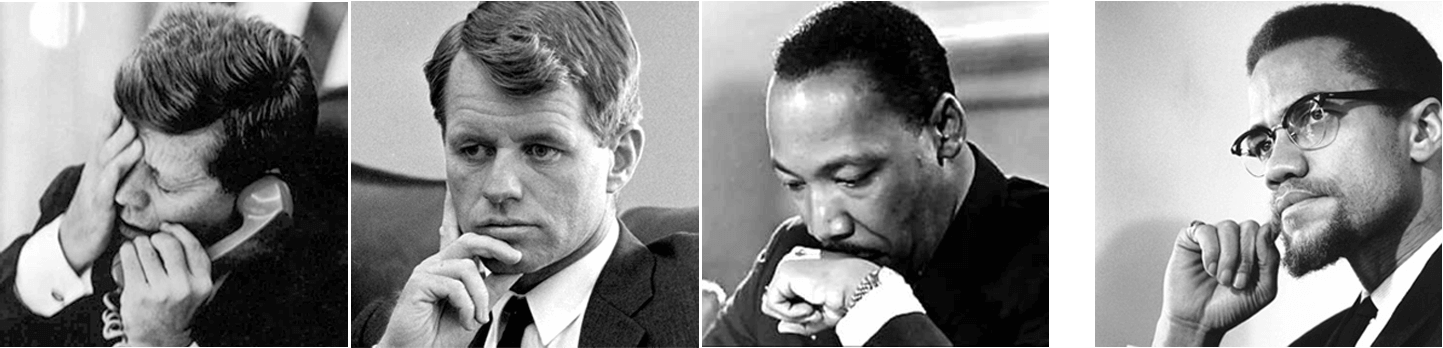
As a result of King’s death, Bobby Kennedy was the last hope left from the sixties. JFK, Malcolm X and King were now all gone--all under the most suspicious circumstances. Yet justice was not achieved in any of those cases. One could argue that justice really did not move at all. Jackie Kennedy did not want Bobby to run in 1968. As author Randy Taraborrelli revealed in his 2003 biography of the First Lady, she said America was too full of hate; the same thing that happened to her husband would now happen to Bobby.
She was right. The Sixties died on the floor of the Ambassador Hotel. It was the end of an era.
But the perpetrators knew they had to come up with something bold and original this time. The scenario of the gunman from a distance, dropping his rifle and going on the lam, had been used in the JFK and King cases. So they decided on a fresh idea. This time, the fall guy would be right in front of the victim, thus making himself obvious. As Lisa Pease calls it in her book A Lie Too Big to Fail, it was really a magic act, a grand illusion, one made up by artists of assassination. It was so daring, so startling, so convincing that the Bobby Kennedy case was labeled The Open and Shut case.
As Pease shows in her book, it was anything but. There were so many problems with the case against Sirhan that a cover-up had to be snapped on quite quickly and completely. Two former CIA assets were installed at the LAPD under the title Special Unit Senator. They did all they could to discredit and confuse one of the key witnesses, Sandy Serrano, and to allow one of the main suspects, Michael Wayne, to escape indictment. (Pease’s work on Wayne is simply stellar.)
This book also goes into detail as to how and why Grant Cooper, Sirhan’s main lawyer, blew the case for his defendant. No one has gone into the Friar’s Club scandal as she has. She also points out the early hero in the RFK case, the now-ignored Pasadena criminalist William Harper. On his own, using his own technology, Harper pretty much exposed what had really happened during the ‘magic act”. But in an important way, Pease goes even beyond Harper to show just how corrupt the LAPD was with the ballistics evidence in the RFK case. It only began with the infamous DeWayne Wolfer.
As her book shows, one does not have to execute the perfect crime to escape justice. One only has to control the cover-up afterwards That is what happened here—so completely and exhaustively, that the general public still has no inkling as to what really happened at the Ambassador. I cannot summarize what did happen any better than the brilliant crusader for truth, Yale lawyer Allard Lowenstein:
Robert Kennedy’s death, like the President’s, was mourned as an extension of the evils of senseless violence; events moved on, and the profound alterations that these deaths …brought in the equation of power in America was perceived as random….What is odd is not that some people thought it was all random, but that so many intelligent people refused to believe that it might be anything else. Nothing can measure more graphically how limited was the general understanding of what is possible in America. (The Assassinations, edited by James DiEugenio and Lisa Pease, p. 633)
That is the riddle that Lisa Pease spent well over two decades trying to solve: why is a case that is actually more clearly a conspiracy than John Kennedy’s, deemed the opposite? As an Open and Shut case for the prosecution. She did an utterly heroic job in explicating how it ended up that way. And in every aspect. A Lie Too Big to Fail is encyclopedic in its scope, and microscopic in its analysis. And since the author is an able writer, it never loses the quality of being a murder mystery. But, unfortunately, this is not fiction. This is the final step of the American political system being demolished in front of one’s eyes. And the demolition was permanent. Because the Democratic Party has never been the same after 1968. As the great French playwright Jean Genet said after RFK’s murder, “America is gone.”
A Lie Too Big To Fail has now been reissued in a second edition. This features a 20-page addendum by the author consisting of new developments in the case; and also her encounter with the late James Phelan, the FBI asset who threatened to sue her for telling the truth about him and Robert Mahue. For reasons made clear in the volume, it was understandable that Phelan would not want that relationship delved into. Because Maheu is a very central character in the architecture of this superb book.
I am not going to reveal the why. I will just recommend you read it and find out for yourself.
________
The updated edition (which is currently available only in the paperback version) may be found here: here.


