
Tommy Rowe: One Connection Too Many
John Washburn
The purpose of this article is to supplement and correct the analysis based on the work of first-generation researcher and journalist Penn Jones, printed in the Midlothian Mirror on August 21, 1971.
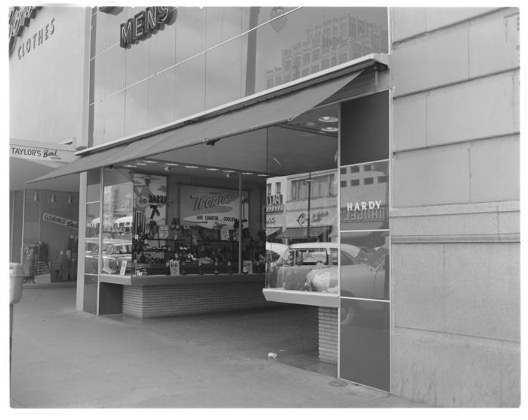
That report was broadly the hearsay that a person called Tommy Rowe, who worked in Hardy’s Shoe Shop 60 yards from the entrance to the Texas Theatre, Oak Cliff, Dallas, had been the person who sighted Oswald acting suspiciously in the recessed foyer to the shop at around 1:40 pm on November 22, 1963. Then, him telling his manager, Johnny Brewer, about it. Thus, setting off a chain of events, causing the police to be informed and raid the Texas Theatre and arrest Oswald.
Then, by that account, Tommy Rowe moved into Jack Ruby’s apartment after Ruby was arrested on November 24, 1963, for the murder of Oswald.
This article presents new information as well as corrections to that original tale. When fleshed out with facts from closer to the time, the hard evidence is more compelling than the hearsay.
The incorrect story revolves around Tommy Rowe moving into Ruby’s apartment after Ruby was arrested. That somewhat softens the connection with Ruby, given that a “Tommy” can be placed in Ruby’s apartment in early November 1963, as a visitor, diner, and temporary co-occupier. Any of which are much stronger connections than his moving in after Ruby’s arrest.
Relevance and context
Bringing in the Tommy Rowe dimension further undermines the accuracy of the Warren Commission’s account. For Brewer’s story was that he had been working alone in the shoe shop that day.
If, instead, Tommy Rowe, as an associate of Jack Ruby, was coached to trigger police interest in the Texas Theatre, then more credence is given to the thesis that Oswald himself had already been inside the Texas Theatre for 30 minutes, having been driven there. The purpose was to set him up to be eliminated either in or outside the theater.
A corollary of such a set-up is that a decoy would be needed to act out a journey in parallel without any apparent assistance. Or else the lone assassin narrative wouldn’t have legs.
In his Warren Commission testimony of April 8, 1964 (Vol VII, p15) theatre ticket taker Warren Burroughs said he didn’t see Oswald enter at the time of the Hardy’s tip off. Nor did ticket seller Julia Postal in her first FBI statement of December 4, 1963, in which she said, “Johnny asked me if I sold that man a ticket. I said, ‘What man’”.
Burroughs’ very brief testimony made no reference to Johnny Brewer by name. He merely referred to the tip-off coming from ‘a man’ and ‘the shoe shop salesmen’. Oddly, there is no FBI statement for Burroughs, despite his role in the arrest situation.
Researcher Jim Marrs said that Warren Burroughs later told him he had served Oswald popcorn around 1:15 pm. Julia Postal told Burroughs, who told Marrs, that she had definitely sold Oswald a ticket. Jack Davis, sitting in the theater, put Oswald as present before 1:15 pm, moving around, sitting next to different patrons as if he was trying to find a contact. Davis also said Oswald left the auditorium and came back in, which corroborates a popcorn sale.
That timing by Burroughs at 1:15 pm alone rules out Oswald as the assassin of Tippit and hence casts doubt on what Brewer claimed to see and do. But there is more to back that up.
Lost evidence - Ruby’s apartment
Jack Ruby lived at Marsala Apartments, apt 207, 223 S Ewing, Oak Cliff, Dallas.
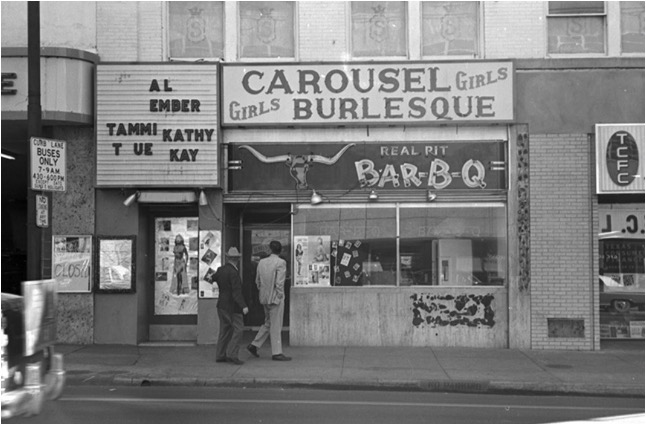
The Warren Commission took testimony (below) from Ruby’s employee, Nancy Monnell Powell. She was a stripper who worked at Ruby’s Carousel Club, with the stage name ‘Tammi True’. She had occupied apartment 208 and placed a young man called “Tommy” as living in Jack Ruby’s apartment 207 in the first week of November 1963, when she visited it after demonstrating a “Twistboard” and Ruby had cooked dinner for them.
Also, the FBI statement of apartment managers Mr. and Mrs. Curtis Warner of November 25, 1963, said that a young man called “Tom” had been a regular visitor to Ruby’s apartment.
There is no evidence that the FBI or police attempted to trace “Tommy”. That is remarkable given the extent to which peripheral contacts of Ruby were interviewed, e.g., Dewey Harris, the gas station operator on 8th at Thornton Freeway. (page 129 of 199 pages of contacts).
Tommy Rowe was not far at hand, given that he was to reside at Marsala Apartments. But, to clarify matters, Rowe didn’t move into the apartment of Jack Ruby (207) after Ruby was arrested. He moved into apartment 206. That apartment had been vacated by George Senator in the second week of November 1963 when Senator moved into Ruby’s apartment.
Here is an extract from the Garrison files for the New Orleans trial of Clay Shaw.
“TOMMY ROWE, who allegedly told shoe store manager OSWALD had gone into theater, until recently lived in Apt. 206 with FREDDIE WOODALL, at Ruby’s last address--223 S. EWING.” Memo from Wm. C. Boxley to Jim Garrison, September, 15 1967, Source, Gil Jesus. (Note: a CIA release of 2002 indicates William Boxley was actually a former CIA agent, Bill Wood.)
Marsala Apartments, 223 S Ewing
From statements by apartment managers Mr. and Mrs. Curtis Warner to the FBI of November 25, 1963, the day after Ruby’s arrest, the Marsala apartment block was brand new in November 1962.
“Mr. and Mrs. CURTIS L. WARNER, Managers, Marsala Place Apartments, 223 South Ewing, 'Dallas, advised they 'have known JACK RUBY since RUBY moved into Apartment 207 about' November 15, 1962. RUBY lived alone in Apartment 207 until approximately one month ago when GEORGE SENATOR who had resided next door to RUBY in apartment 206 moved in with him.
“He also had a fairly young man visit him on occasions whose first name was TOM. His last name is unknown but they believed him to be in his 20's, about 5"7", brown hair and medium-build. They could furnish no further information which could assist in identifying TOM.“
The testimony of Nancy Monnell Powell (‘Tammi True’) was taken at 11 a.m., on July 25, 1964, Vol. XV, 404–430.
Mrs. Powell. He [Jack Ruby] was always picking people up off the street or something, that didn’t have a place to stay or any money or a job or anything. He just had all kinds. Well, he had this one guy who used to sleep in the club. We had three or four guys sleeping in the club every night because they didn’t have a place to stay. And he would give him $2 or $3 a day, and they were sort of flunkies.
Mr. Griffin. Do you remember the last fellow, Larry Crafard?
Mrs. Powell. Isn’t he kind of a carnival guy?
Mr. Griffin. That is the fellow.
Mrs. Powell. Yes; I remember him.
Mr. Griffin. Do you remember anything about Jack’s twistboard?
Mrs. Powell. Yes. I demonstrated his twistboard here in the building with the exhibits.
Mr. Griffin. Texas Product Show?
Mrs. Powell. Yes.
Mr. Griffin. How many times did you go out to demonstrate?
Mrs. Powell. Just once.
Mr. Griffin. How long were you there?
Mrs. Powell. Oh, about 30 minutes to an hour. Jack called me, and I went there before work one night, and then I went home with him and he cooked lamb chops.
Mr. Griffin. What did you do, get up on the board?
Mrs. Powell. There was another boy, he had picked up by the name of Tommy.
Mr. Griffin. He had another fellow?
Mrs. Powell. At this time that I was demonstrating the twistboard, there was this boy living with him. His name was Tommy something, and he was staying with him the last time I was there.
Mr. Griffin. Living in Jack’s apartment?
Mrs. Powell. Yes. Because they came out there, and we went to the apartment, and Jack cooked dinner for us all.
Mr. Griffin. How old a fellow was Tommy?
Mrs. Powell. About 25, I guess.
Mr. Griffin. What did he look like?
Mrs. Powell. Well, I think he played—he told me he had played baseball. He looked like a baseball player. Baseball players all look alike, sort of athletic type, but not musclebound.
Mr. Griffin. About how tall?
Mrs. Powell. About 5´ 11´´, had brown hair, and I think he was from Iowa or someplace like that, a really nice kid. And he had a job; he was working though.
Mr. Griffin. Where was he working?
Mrs. Powell. Gee, I don’t know.
Mr. Griffin. In Dallas?
Mrs. Powell. Yes.
Mr. Griffin. How long had Tommy been living with Jack?
Mrs. Powell. I don’t know. He was living with him when I came back for work the last time, I believe.
Mr. Griffin. When did he move out?
Mrs. Powell. You got me, I don’t know. I mean, I didn’t keep up with all of these guys. He just picked guys up.
One night he had this boy up there, and he said, “You are going to Fort Worth. I want you to give this friend of mine a ride.”
And I said, “OK.” He says, “He goes to college at TCU [Texas Christian University, Fort Worth], and you can drop him off.” And I said, “OK.”
And the kid is working around there, and when I get ready to leave and I get him in the car and we pile his books in at the bus station, and I start on the turnpike, and I said, “How long have you known Jack?”
And he said, “I don’t know him. I didn’t have enough money to get to Fort Worth, and I started talking to him on the street, and he told me to come up to the club and he would give me a couple of dollars to work, and then he got me a ride.”
So, regardless of whether Tommy was eating or sleeping there that week, he can be placed in the apartment. Then this.
Mr. Griffin. New Year’s Eve of 1963 you said you were working for him——
Mrs. Powell. I lived over here for a while in the same apartment building he did.
Mr. Griffin. Did you live on Ewing Street?
Mrs. Powell. Yes.
Mr. Griffin. 223 South Ewing Street?
Mrs. Powell. Yes.
Mr. Griffin. Jack didn’t move there until about the first of the year?
Mrs. Powell. We moved in at the same time.
Mr. Griffin. You did?
Mrs. Powell. Yes.
Mr. Griffin. Were you living with him?
Mrs. Powell. No. I wasn’t living with him, the ugly thing. I had an apartment. I presume you have seen his apartment and everything and know about it. My apartment was right here.
Mr. Griffin. Across the hall?
Mrs. Powell. Actually, I was away down here in the corner, and you had to walk around this corner, and my apartment was right here.
And.
Mrs. Powell. Now, in January I lived there. I moved in about the same time he did, because the apartment was a brand new building, and I was living down on Ewing, but further down, and there were a bunch of people living there that were kind of loud and it wasn’t a very good environment, and Jack didn’t think I should live there, and they were always fighting and calling the police, and he looked at this apartment, and he was going to move in.
He was real enthused about them, they were so great, and he got me to go down there and look at them, and I got an apartment there, because I don’t like to stay by myself. I am real scary. I always think somebody is going to follow me home and do something to me, and I wanted to live in the same building as Jack so if I had any trouble, I would get him to help me.
She was interviewed by the FBI on November 24, 1963, in Dallas, the same day Ruby shot Oswald. She was interviewed again on November 25, 1963, this time in Oklahoma (“Powell Exhibit 2”), and appears to have been interviewed twice that day.
Edward J. Pullman testified to the Warren Commission on July 24, 1964, Vol XV, p. 222. He owned the Twistboard, and said that the Texas Product Show took place 1st to 7th November 1963. His testimony corroborates Nancy Powell’s account regarding the events and dates.
Pullman said this, the “him” being Jack Ruby.
Mr. Griffin. What month was this?
Mr. Pullman. That was in November—the early part of November—I think it was the first week in November, and that’s when he contacted me. It seemed very coincidental—I hadn’t heard from him in months and he called me and he told me he had this twistboard and he needed some idea as to how to merchandise it or what to do with it, and he was always running into various things. He had this English razor blade that he was even trying to sell some of them in his club.
And
Mr. Griffin. Did you know Tammi True?
Mr. Pullman. I knew of the girls.
Mr. Griffin. Did you know Kathy Kay?
Mr. Pullman. Wait just a minute; was Tammi True the one he brought—the name rings a bell—I think he brought her out to the product show to demonstrate—she demonstrated the board. They got her picture.
George Senator – apartment 206
The information in the Warren Commission George Senator file is extensive and is the source of the information here unless cited otherwise.
George Senator was an old acquaintance of Ruby and Jewish, like Ruby. He divorced in 1956 and was a man down on his luck, in and out of work. He had shared accommodations before with Ruby elsewhere for a short time in 1962, as he had nowhere to live, but found Ruby messy in his habits.
Senator moved into apartment 206 in November 1962, with a friend, Stanton Corbat, also Jewish. Senator told Ruby of the brand-new apartments, and Ruby took apartment 207 shortly after Senator’s occupation of 206. Corbat moved out upon his marriage on August 10, 1963. Senator was unable to afford the rent after Corbat moved out and moved into apartment 207 in the second week of November 1963.
Hence, Senator only shared the Marsala apartment with Ruby for 2-3 weeks before Ruby was arrested on November 24, 1963, for the shooting of Lee Oswald.
Senator’s November 24, 1963, FBI interview, contained in Commission Exhibit 5401, corroborated Nancy Powell’s story.
“SENATOR on some occasions would refer to RUBY as a "boy friend" and described him as extremely good-hearted and considerate of others and in this regard SENATOR said RUBY would frequently take some acquaintance or casual friend home to stay with ''him for a short time because this individual was having a "bit of hard luck".
Penn Jones and Roger Craig
What Tommy Rowe seems to have done is stayed (or eaten) in apartment 207 in the first week of November 1963, and then moved into a vacant 206 at some date after Ruby was arrested.
This is an extract from an interview with Roger Craig and Penn Jones, March 1, 1968, with the Los Angeles Free Press.
“Free Press: Three doors down, and the manager just happens to be standing there in the theater entry watching the door. And he saw a man slip in, and they call the cops. So when the police hear the description of this movie crasher, they immediately recognize the description of Tippit's killer—is that it?
Penn Jones: Yes, that might be what we're supposed to believe.
FP: Do you know the shoe store manager?
PJ: I've never talked to him, The one I've been interested in is an employee who was working for this store manager. He was a good friend of Jack Ruby's, and shortly after the assassination he moved into Ruby's apartment and lived there for over a year.
FP: What is his name?
PJ: His name is Tommy Rowe. I never have been able to get to Tommy Rowe to talk to him. I've been to his apartment at least a dozen times, and finally my calls got so numerous there that he moved, and when I asked the manager of the apartment house where he moved to, she said, well, he'd gone back to his parents, and I said where do his parents live, and she gave me a great big grin and said "I don't know" So I've never been able to find Mr. Rowe.”
Roger Craig also said this, which indicates he thought Oswald was set up.
FP: Do you think these rather important people — like Alexander, the District Attorney's prosecutor — responded to the call from the theatre because they believed Tippit's killer was presumably in the theater?
RC: Well, I think that's what they'd like us to believe. There were also five or six police in the front of the theater. They went in and turned on the lights, to begin with. And their man—which was Oswald—was pointed out to them by the manager of the theater. Instead of going directly to him, they began looking seat to seat, row to row, giving him time to run out the back door.
PJ: McDonald searched six people out of the 24 in there, going from row to row until he got back to Oswald.
FP: You think he was supposed to run out the back door?
PJ: Yes. I can't understand why you're going to stop and search six people when you know who the man Is you're looking for. What's the purpose? They're waiting for something to happen, and he's not doing something. That's speculation, of course. —And then, when McDonald got up to Oswald, he said something —we don't know what was said— Oswald looked at his watch and said, guess it's over! You know, they've turned the lights on—I guess it's over. What McDonald said to Oswald I don't know, but Oswald knocked Officer McDonald cold. Knocked him out. Fell right in the aisle. Then the other officers came in and captured Oswald.
FP: How do you know what Oswald said?
PJ: The other officers testified to that—but they put a different interpretation to It. They said that he said, “Well, it's all over now” meaning “Well, I'm caught, and this is it.” Other officers who have made themselves—who have said, but not given their names— said that he looked at his watch and said, “Well, I guess it's over”.
Oswald himself, with his “I’m just a patsy” statement on the evening of November 22, was obviously implying a conspiracy that had dealt him a bad hand. But a patsy needs to be silenced.
Oswald’s behavior upon the police entering the theater is perhaps consistent with his realizing he was set up, i.e., throwing a punch in order to be arrested. The assumption being that custody would be safer for him.
When corrected for historical inaccuracies, those people who have suspected a link between Rowe and Ruby are more correct than they may realize.
All of this is clearly a stronger association than Rowe moving in after Ruby was arrested. Which could have been a coincidence.
Johnny Brewer
The FBI records show unusually late FBI statements of Johnny Brewer. Other proximate witnesses were interviewed within 3-4 days of the Kennedy and Tippit assassinations.
But, rather surprisingly, Brewer’s first FBI interview wasn’t until February 28, 1964. His first statement was an affidavit for the County Sheriff’s office dated December 6, 1963, which was a Friday, two weeks after the assassination of JFK. His account does not align with that of on-the-scene police officers because he did not refer to the incident where Officer Hutson pulled a gun on the person (who would be Brewer by Brewer’s own account) who opened the rear doors of the theater.
Hutson said:
“As I walked up to the fire exit doors, Officers Hawkins and Baggett were getting out of the car, and the door to the theater opened, and this unknown white male was exiting. I drew my pistol and put it on him and told him to put up his hands and not to make a move, and he was real nervous and scared and said: “I am not the one. I just came back to open the door. I work up the street at the shoe store, and Julia sent me back to open the door so you could get in.” I walked up and searched him briefly, and I could see by the description and his clothes that he wasn’t the person we were looking for. Then I entered the theater from this door, and Officer Hawkins with me, and Officer Baggett stayed behind to cover the fire exit door.”
The ‘stick ‘em up’ pulling of the gun, and being scared and nervous are featured in none of Brewer’s statements.
His first FBI statement of February 28, 1964—over two months after the murder of JFK—now included an important addition: that he had heard on the radio of a police officer (i.e., Tippit) being shot, and it was that which raised his suspicion of the person outside his shop.
But that did not completely jibe with ticket booth clerk Julia Postal. Her first statement was in a December 4, 1963, affidavit to a notary (hence missing an FBI statement). In it, she said she was listening to KLIF Dallas for news of Kennedy’s shooting. She made no mention of hearing on the radio of an officer being shot.
On 29 February 1964, she eliminated that possibility. She said she first heard about Tippit being shot from an arresting officer who said, “we have our man on both the counts” and she asked who the second person was.
“She said this was the first time that she had heard of TIPPIT's death, and the officers arresting OSWALD had identified him, OSWALD, to her by calling his name.”
She repeated that in her Warren Commission Testimony (VII, 8–14).
“So, seemed like I hung up the intercom phone when here all of a sudden, police cars, policemen, plainclothesmen, I never saw so many people in my life. And they raced in, and the next thing I knew, they were carrying—well, that is when I first heard Officer Tippit had been shot because some officer came in the box office and used the phone, said, "I think we have got our man on both accounts." "What two accounts?" And said, "Well, Officer Tippit's," shocked me, because Officer Tippit used to work part time for us years ago. I didn't know him personally.”
That usage of “both accounts” also contradicts the official line that a link to the Kennedy assassination only occurred after Oswald’s arrest and transfer to City Hall.
Also, Brewer claimed to be on his own in the shop. But he made no mention of the dilemma of leaving the shop unattended on the basis of a mere hunch. No mention either of leaving it unlocked. Particularly relevant in an era of cash sales.
Brewer’s FBI statement of February 28, 1964 introduced a statement in which he said he had no connection with Jack Ruby. Why would that need to be said if it was Oswald appearing outside his shop, and his reaction to it was merely happenstance?
Other factors relevant to a Tommy Rowe factor in the case
My October 1, 2025 article for K&K set out that the bus transfer supposedly found on Oswald was for the wrong bus Line 23, Lakewood. That ran from north Dallas to Downtown and back. Whereas, Oswald’s supposed route to Oak Cliff was the north-south ‘Marsalis’ Line 30 (which ran back as ‘Munger’).
I concluded that the wrong bus transfer had been planted on Oswald at the time of his first line-up, but was punched for the wrong line. Because the driver of the 12:40 pm Marsalis bus had later switched lines by the time the transfer was produced.
My July 23, 2025 article for K&K covers Larry Crafard (looking somewhat like Oswald) who was living at the Carousel Club from October 1963. A scope for misidentification was flagged to, and then by, Naval Intelligence on November 25, 1963. But anyone else who made similar observations was actively discredited.
Crafard himself had false and shifting alibis for the morning of November 22, 1963. Crafard also had a suspicious account of his rapid departure from Dallas over the weekend of November 23/24. His times do not stack up. In hitchhiking to relatives in rural Michigan, he appears to have spent up to a day enroute in the vicinity of Chicago.
My October 1, 2025, article also covered how Deputy Sheriff Roger Craig said he had seen Oswald - who he saw up close again that day at City Hall after his arrest - getting into a station wagon on Elm Street. This was about 10 minutes after the shooting in Dealey Plaza, and the car headed towards Oak Cliff.
Earlene Roberts, the housekeeper of Oswald’s apartment house, 1026 N Beckley, was also associated with Jack Ruby via her sister, Bertha Cheek. Cheek was thinking of investing in Ruby’s Carousel Club in November of 1963.
My June 17, 2025 article for K&K set out discrepancies in the official line which depended on a warrant being granted before a search of Oswald’s room was done after 4:30 pm. But it appears that 1026 N Beckley was visited and searched by police officers much earlier than that. I deduced that the earlier searching had been triggered by a wallet planted at the Tippit murder scene, to implicate Oswald, but that the first responders then searched 1026 before evidence had been planted in his room.
My July 3, 2024 article for K&K. set out the suspicious behavior of Officer William Mentzel, who took lunch across from the Texas Theater from 12:30 pm that day. He claimed to be incommunicado but wasn’t. His radio calls were not transcribed, and his story changed over time.
Mentzel was close to Tippit at two locations shortly before Tippit was shot at around 1:09 pm. Firstly, at Luby’s Cafeteria, close to Top Ten Records, from where Tippit made a landline call at around 1:00 pm. Secondly, he was near the Mobil gas station at the junction of Sunset, Beckley and E 10th Street between 1:04 and 1:07 pm. That gas station also had a landline used by police officers.
J. D. Tippit, heading north from Top Ten, and then east along Sunset, and then along E10th to the scene of his death, would have passed that gas station at around 1:07 pm.
My February 17, 2025 article for K&K covers the fact some police officers were already progressing to the Texas Theater, before the alert on patrol radio could have been the trigger.
My very first article for K&K of April 30, 2024 set out how patrol radio tapes were tampered with to alter the timing of Tippit’s death (to fix times for a fleeing Oswald to be able to get to that scene), alter positions of a handful of officers, as well as not transcribing or mis-transcribing relevant calls.
Taken with the other discrepancies, I suggest there is a strong case that it was his assistant Tommy Rowe who triggered the alarm as a contrivance.
Had Oswald been killed at the Texas Theater, then Jack Ruby would not have featured as a person of interest, and Tommy Rowe could have been taken as just an ordinary member of the public.
But with Oswald not being killed at the theater, but two days later by Jack Ruby, then having someone else with a link to Ruby would be one connection too many. Hence, Brewer had to be the person to whom attention was given, with a story that ignored Rowe’s involvement.
Who was Tommy Rowe?
There are two Thomas Rowes in the 1961 Dallas City Directory; one can be discounted by his occupation of service station attendant. But a Thomas J Rowe is listed as “student” at 1823 Marydale Road, which is in West Dallas, 3 miles from Hardy’s.
That address also has a Naunearle Chiles as living there with him in 1961. That is the maiden name of Naunearle Rowe, a widow (1910-1987, born Texas) who married Mr Marion Harper Rowe (1909 -1950, born Nagasaki, Japan), and they had one child, Thomas Jesse Rowe (1943-2008), born in Indiana.
The 1963 Dallas City Directory has “Tom Rowe, student, 2435 W. Jefferson Blvd”. That is 2.3 miles to the west of Marsala apartments, 1.2 miles west from Hardy’s shoe store and 1.2 miles south from his mother’s house. Given the time lag in preparing city directories, the 1963 entry would predate living arrangements in November 1963.
Thomas Jesse Rowe, born in Indiana in 1943, is therefore consistent with a man who would appear to be 20-25 years of age and Nancy Powell’s description of “from Iowa or someplace like that”.
Sometime between 1961 and 1963, he ceased living with his widowed mother.
Conclusion
The matter of Tommy Rowe follows patterns covered in my other articles. A lead was not followed up by the investigating authorities despite contemporaneous evidence. Inconsistencies between witnesses.
But overall, a link with Jack Ruby that throws more light on the potential role of Ruby, not as an assassin or co-assassin of Kennedy nor Tippit, but as an enabler of a necessary parallel plot to give false movements to Oswald.
It is interesting that the Penn Jones interview states, which predated the public showing of the Zapruder film, that Kennedy was shot first in the back from the DalTex building, then in the throat from the front and finally in the head from the grass knoll.
He stated Connally was shot in the hand and thigh from the roof of the Texas School Book Depository, and then in the chest from the roof of the County Records office. With a further wasted shot which ricocheted a fragment which hit bystander James Tague.
With only three audible shots, that scenario indicates a combination of silenced shots and audible shots. With that, the Tague shot was a deliberate miss for the purpose of providing a third audible shot, given that only having two audible shots would clearly not be explainable.
The involvement of a few police officers is consistent with Soviet Intelligence, which said the assassination of Kennedy was a far-right-arranged plot assisted by rogue elements of the Dallas Police Department.
I have postulated that the death of Tippit was caused by his abandoning his role in the decoy scheme, mid-operation. Thus, he needed to be rapidly eliminated by the impromptu actions of rogue officers. Those being Westbrook, Hill, Croy and Mentzel, as well as Officer Olsen.
But that impromptu nature of Tippit’s killing caused the plan to kill Oswald at the theater to fall out of the sequence, largely due to the number of non-complicit officers arriving in Oak Cliff.
End-piece
None of this analysis is a criticism of early researchers. Digitised versions of the Warren Commission testimonies, FBI reports, etc., were not available. Less so the ability to rapidly search files for people or phrases.
Modern policing techniques have developed with precisely the same new capabilities. These have, in some cases, led to cold case solutions of unsolved crimes or reappraising those where miscarriages of justice occurred.
Without access to original documents, researchers often need to rely on other researchers. Hence, errors and gaps in information will propagate. More so where research has not been conducted in good faith.
Where criticism should be placed is towards those who, despite newly available information resources, continue to find elaborate excuses for a deeply flawed Warren Commission and FBI investigation.
Truth unravels in the simplest of ways. Lies require lies on top of lies to be sustained until the heap collapses.
My work hasn’t merely looked for errors that contradict the Warren Commission’s conclusions. It has set out omissions and new information. I have found the only way to unify all of the evidence is to provide a more credible alternative explanation of events.
But fundamentally, Lee Oswald was either a patsy or he wasn’t.
As my November 3, 2024 article for K&K set out Counsel Hubert and Griffin did consider the possibility that Oswald was indeed set up with the involvement of an impersonator. But that line of enquiry was lost.
The truth of the ballistics was most plainly visible once the Zapruder film was available to see publicly.
CBS’s Dan Rather - when that film was not publicly available - described and even imitated a forward head movement of Kennedy. The film itself presents a violent recoil backwards and a fall to the left side towards his wife’s lap.
Rather also failed to mention Kennedy clutching his throat following a shot prior to that.
Essentially, Rather was describing a narrative consistent with three shots from the rear and above, whilst the film shows nothing of the sort. But even Rather’s deficient description doesn’t give room for the later concoction of the ‘single bullet theory’.
The masking of Ruby’s acquaintance with Tommy Rowe is consistent with all else that is wrong with the work and conclusions of the Warren Commission.


