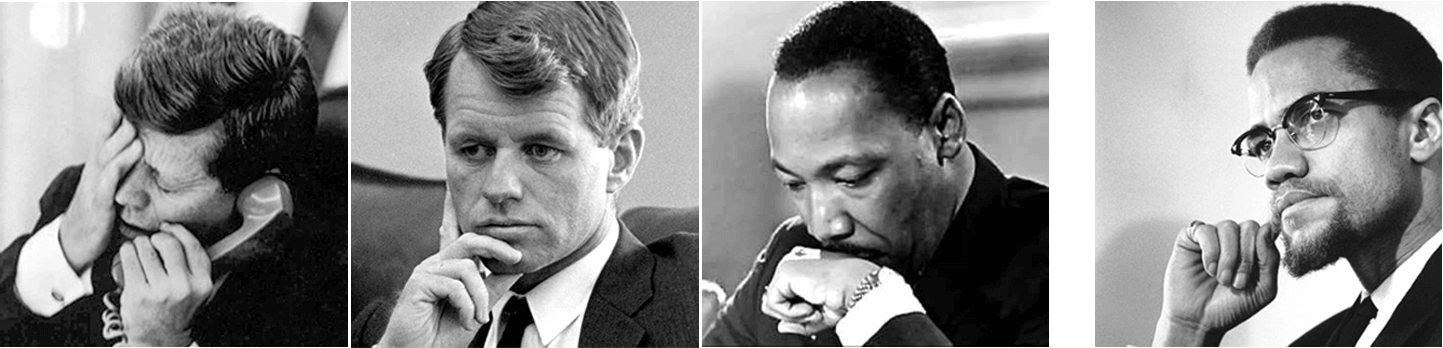

George's Haiti scheme done with the consultation of Dorothe Matlack does not succeed. But now with the JFK assassination, both the American embassy and the FBI start to take a more active interest in him. This ends with a private dinner with the Bouviers and Allen Dulles, and closes with a cold message of disassociation.
George de Mohrenschildt:
Reconsidering Oswald's Eccentric "Babysitter" – Part 2
By Dan Carbone
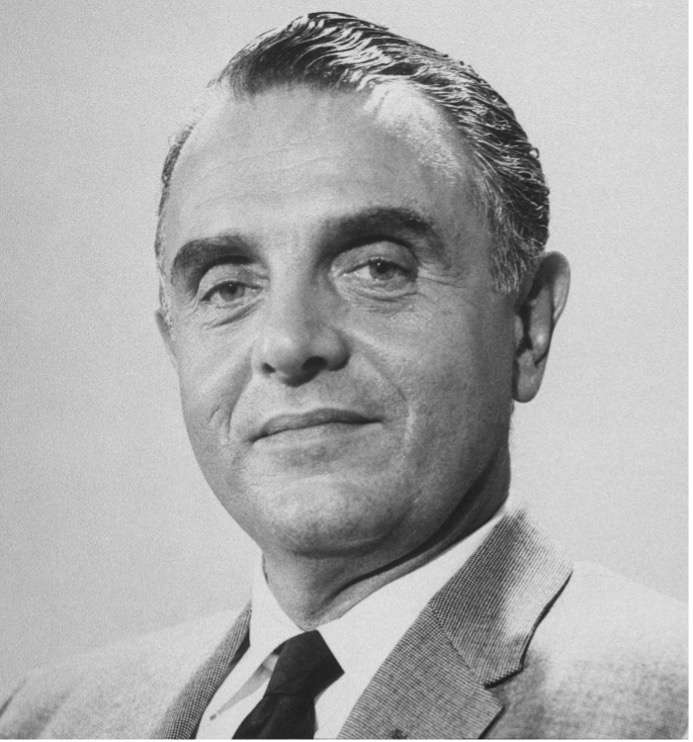
The Backstory II
New York, Washington & Haiti
As documented in Russ Baker's Family of Secrets,[1] and Joan Mellen's Our Man in Haiti,[2] immediately following the Dallas General Walker assassination attempt (detailed below in George Finishes His Manuscript) George had enough of Oswald, but he might well have discussed his recent friend's activities with others as he took off for a series of clandestine meetings with various high level Intelligence officials in New York and Washington, during April & May 1963, with a stop off in Haiti to resume schmoosing President Duvalier regarding an oil exploration contract. Along the way, he picked up Haitian Bank Minister Clemard Charles, who accompanied him to DC.
Army Intelligence Specialist Dorothe Matlack
& A Coup d'état in Haiti
One of the crazier meetings was related by Army Intelligence Specialist Dorothe Matlack (aka "Dorothy") in her testimony before the HSCA in 1978.
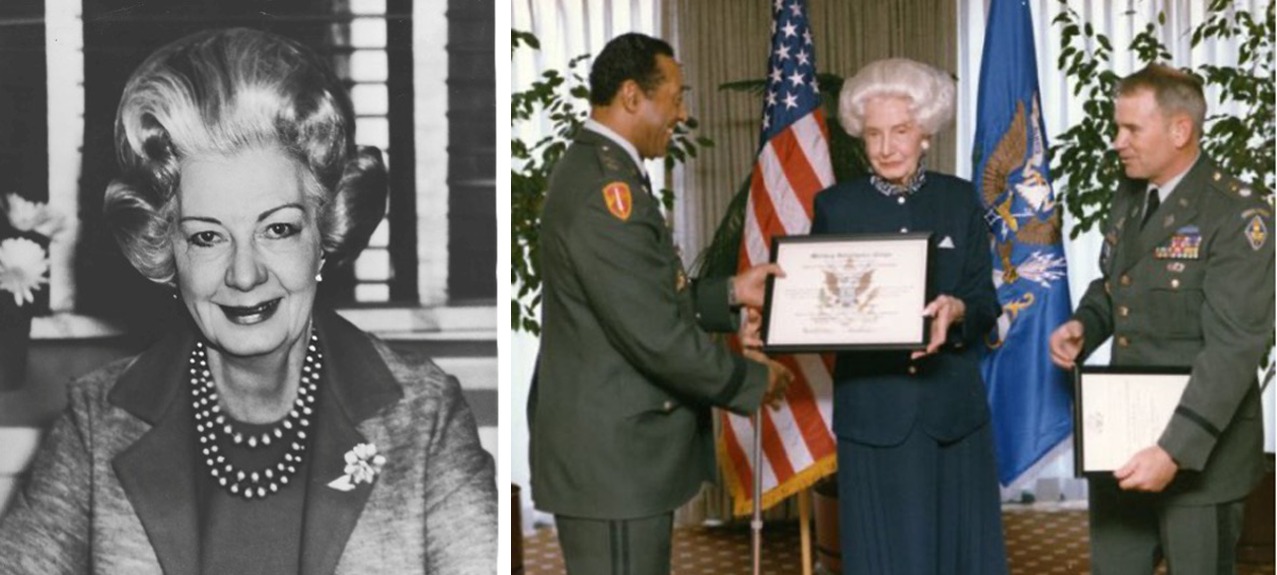
Army Intelligence Specialist Dorothe Matlack circa 1962 & 1987
The de Mohrenschildts and Clemard Charles, a banker and trader, met with Matlack in a Washington restaurant booth under the guise of promoting US investment in a sisal plantation in Haiti (sisal is a fiber extracted from the agave plant family). Sisal is the primary compound in creating a rope for military use that would be near indestructible to salt-water. As the trio gabbed away boisterously, Matlack would later state she felt that George "dominated Charles in some way." Matlack observed that everyone was acting so dramatically the experience was "like watching some bizarre play unfold." Charles and the Baron eventually got around to the real reason for the meeting - a coup d'état to remove Duvalier and replace him with Charles. "I knew the Texan wasn't there to sell hemp," stated Matlack. Charles felt Duvalier was so tightly surrounded by security that that a US military invasion was the only way to remove him. Matlack was appalled the 2 men were loudly advocating for Duvalier's overthrow in such a public setting. She testified she didn't trust either one of them. And though Matlack claimed to have nothing to do with them again, this proved to be untrue. She was in deep. When Charles was imprisoned by Duvalier four years later for his attempted overthrow, Matlack spearheaded the Intelligence effort to get him out.[3] And she would be waiting at the airport to pick up the de Mohrenschildts when they arrived in Washington for their Warren Commission testimony in 1964.[4]
The JFK Assassination
The de Mohrenschildts first heard about JFK's Assassination at the Lebanese Embassy in Haiti where they were attending a cocktail party. The very next day they went to the US Embassy in Port-au-Prince to volunteer what they knew about Oswald where they were interviewed by First Secretary Norman Warner, during that interview they were already voicing their skepticism about Oswald as the assassin. Warner in turn immediately informed FBI Director, J. Edgar Hoover. De Mohrenschildt was not unfamiliar to Hoover. He had been trailing de Mohrenschilt for years since his arrival in the states, unable to pin anything on him, and now this. What must he have thought? George also began writing letters to friends in the States voicing skepticism and tying his association with Oswald to J. Walton Moore. These letters were immediately forwarded by the recipients to the FBI.
The de Mohrenschildts believed their US Embassy interview would be strictly confidential, yet within days Secretary Warner had leaked their interview to the press. The couple were frightened and outraged when the first articles linking George to Oswald appeared in the Haitian newspapers.[5] It wouldn't be long before the story would be picked up by the world press. Why would a government official stick his neck out like this unless he was instructed to do so. Remember, there was still a very active investigation underway. In a normal case wouldn't you want to protect the witnesses? Not so with the JFK Assassination.
George Becomes The Victim of "A Limited Hangout"
George became the immediate victim of what is known in Intelligence jargon as a "limited hangout." A partial truth revealed by Intelligence sources in order to distract from a larger truth. George's cover was effectively burned by the US Government itself. George was rightly terrified he was being set up. Though he was a US citizen he was also a "Russian" immigrant during a time when all things "Russian" aka "KGB" were suspect. He had also been accused of being a Nazi collaborator and a communist. Until now all were private government investigations. The accusations would now be tossed about and speculated upon by the press in full view of the public for the rest of his life. Thus placating the public's curiosity for conspiracy. The victim is "hung out." It is heavily hinted the "Friend of Jackie Kennedy and Commie Oswald" is a KGB agent. The finger points toward Russia. How mysterious! But what about J. Walton Moore? How come that part of the story wasn't leaked? George revealed his link to Oswald via J. Walton Moore to Secretary Warner and others, yet somehow that particular part of the story would remain hidden until 1977 when he finally leaked it to Edward Epstein during the last act of his life. And Epstein would have his own troubles revealing it to the larger public.
And that wasn't all. An official Washington letter would soon be sent to Duvalier describing George as a "Polish Communist" which was the beginning of the end for George in Haiti. Though he would remain there for 2 more years it was all downhill from there between him and the Haitian government. Duvalier now wondered if the good friend of Kennedy's assassin had been sent to assassinate him as well. And who could blame him? Duvalier eventually reneged on George's oil exploration contract and all of George's geological maps were confiscated by the Haitian Government. George would spend years attempting to get the US government to litigate on his behalf to no avail.
As the days progressed, George and Jeanne vacillated between accepting the government's lone-assassin conclusion and their own doubts based upon their personal friendship with the man. Though some things added up, such as the telescopic rifle that suddenly appeared in Oswald's apartment, other things did not. Oswald had always praised Kennedy, the exception being his criticism over the Bay of Pigs fiasco and the Cuban Missile Crises. But a lot of people were angry at the Kennedy Administration over those issues, unaware of the internal insanity facing the President at the time.
George Finishes His Manuscript
During the month of June, 1976 George had finally finished writing a manuscript about his friendship with Oswald entitled, "I AM A PATSY! I AM A PATSY" [6] It was first published in its unedited typewritten form in the 1979 HSCA Report, and republished in 2014 in an edited, annotated version under the title, Lee Harvey Oswald: As I Knew Him.[7]
Having long since given up on his oil ambitions, and further ostracized by the Dallas Russian Community because of his association with Oswald, George had settled down to teaching language at the African American Bishop College in Dallas. Now in his seventh year of teaching, he was well-liked by his students.
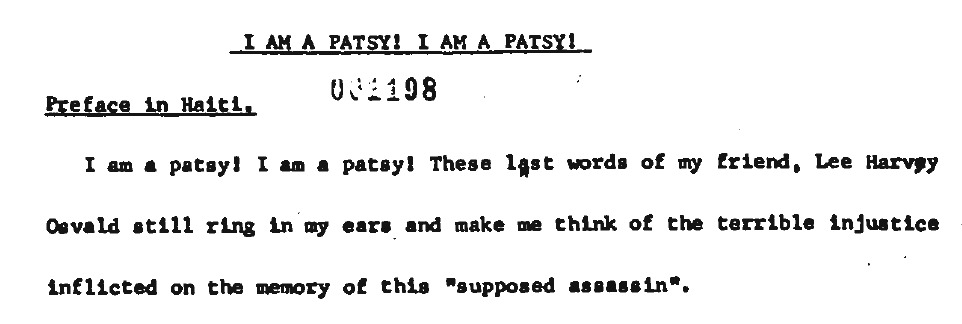
Figure 2 (HSCA Vol XII, March 1979) p 70
Tired of others telling his story, George took it upon himself to write his own. He'd been working on the manuscript on and off since around 1967, maybe earlier, when he and his wife Jeanne began making private tape recording their stories. These initial tapes are presumably lost, though several more hours of tapes of George reciting from his manuscript and discussing various events along with his wife, recorded in 1969 at a CBS studio in Dallas have survived. The tapes were produced by Dutch journalist, Willem Oltmans, a reporter with a history of questionable ties and alliances.
By all accounts George was a fascinating raconteur and storyteller but he was not a professional writer. And he knew so himself, as he honestly writes in the manuscript's final passage:
Let us hope this book, poorly written and disjointed, but sincere, will help to clear up our relationship with our dear, dead friend Lee [8]
When I first got onto the internet in around 2000, George was one of the first people I had looked up. At time there was very little information but I found some links to his manuscript in the National Archives. I was completely shocked he had written a book at all. I knew him as a man on the run, hunted by various government agencies. My view of him at the time was as some sort of KGB/CIA connected neo-Nazi. As I collected information on him over the years, my view would gradually shift. Sometimes I'd find him despicable, other times as near downright heroic. As with all things connected to the JFK labyrinth one must continue to keep an open mind.
Looking at his typewritten manuscript, at first glance I wondered, did George really write this? How come I'd not heard about it before? Is this some sort of fabrication? But then I actually started reading the manuscript, written in broken English with numerous misspellings and corrections. Many pages were devoted to George's love for his Manchester terrier dogs Nero and Poppaea, and the dogs' relationship to Oswald.
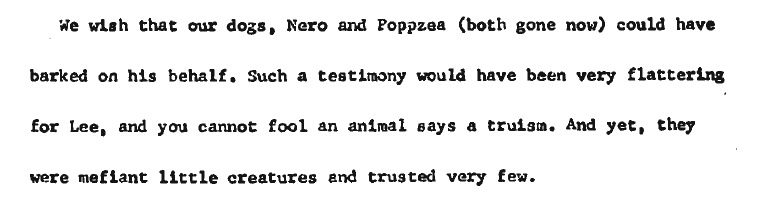
Figure 3 (HSCA Vol XII, March 1979) p 273
Throughout the book George always returns to the dogs. And his wife Jeanne would as well, in her interviews. I see it as an unconscious way of viewing the unrelenting horror the couple found themselves surrounding them. The dogs are the only honest beings they can trust.
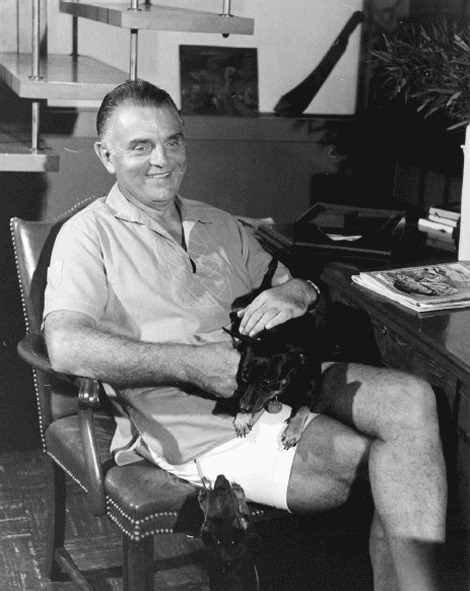
George and Nero circa early 60s
Other pages were devoted to Oswald's favorite jokes! No one could make this stuff up!
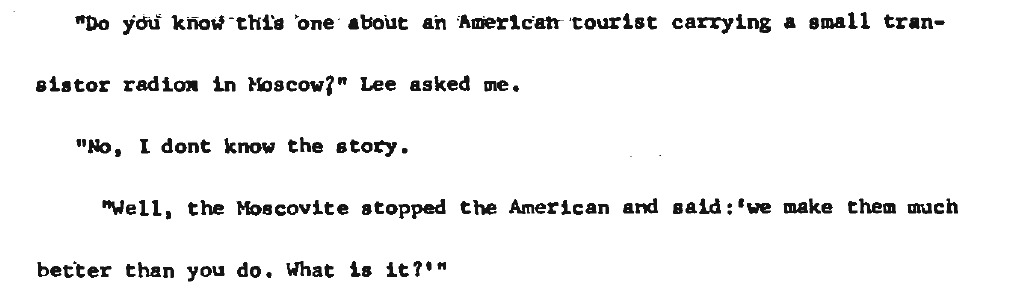
Figure 4 (HSCA Vol XII, March 1979) p 88
In his own way George was attempting to show the human side of Oswald for the first time anywhere, other than the one-dimensional monster portrayed in the media. Marina Oswald once said she had never seen her husband portrayed accurately in any media. Norman Mailer made some sort of courageous effort to paint a fuller picture of the man in Oswald's Tale[9] . But George had already addressed the complex dimensions of Oswald's personality in a straightforward way, years before, ultimately repeating what he had been saying over the past 13 years - that he didn't feel Oswald was capable of killing JFK.
George Names Names
Jeanne panicked upon reading the final version of the manuscript in June, 1976. There was ample reason for her alarm. George had named names. Not only did the pages of his manuscript attack fired CIA Director Allen Dulles and the Warren Commission, he also castigated members of the Kennedy family for their complete incuriosity about the assassination investigation. If that weren't enough, another part casually mentioned specific foreknowledge about the Bay of Pigs invasion that wouldn't become public till decades later.
The Man Of A Thousand Faces
"de Mohrenschildt possessed "an eclecticism that made him delight in presenting himself as right-wing, leftwing, a moralist, an immoralist, an aristocrat, a nihilist, a snob, an atheist, a Republican, a Kennedy lover, a desegregationist, an intimate of oil tycoons, a bohemian, and a socialite, plus a quondam Nazi apologist, once a year." – Norman Mailer[10]
As previously mentioned, George was also a foreign language Professor, well-liked by his students, and a highly respected oil geologist who discovered the largest oil well in Southeast Asia.[11]
As Russ Baker points out, George told the Warren Commission as an oilman he had worked for the CVOVT, (Cuban-Venezuelan Oil Voting Trust Company). Though it meant nothing to the Commission, who specialized in looking in the opposite direction, this meant that George was "no rogue operator or bohemian," but was in fact…
…at the center of a major corporate effort, involving many of America's largest institutions. Through connections in the Batista regime, the CVOVT had managed to corner exclusive exploration rights to millions of acres on the island. Like all foreign businesses operating in Cuba, it had to work through the dictator's American intermediaries, notably the mobster Meyer Lansky, who was de facto representative of American 'interests' on the island.[12]
It seems the list is endless of all the things George could be, but you will notice the one thing that is not on the list is "psychotic depressive," not until the last five months of his life, that is, when he was diagnosed as such.
Was George driven mad?
No sooner had George finished writing his Oswald manuscript, during that same month of June, 1976, he began seeing a local doctor for a bronchial infection he developed along with high blood pressure. In a subsequent interview with Jim Marrs in 1978, Jeanne stated:
In June, someone,I have thought about it and thought about it, recommended that George see this new doctor in Dallas. His name was Charles Mendoza. This doctor told George that he could help with his bronchial condition without hospitalization, which George detested. But Mendoza said George would have to visit him two or three times a week at his office. So George began his visits to the doctor, happy that he would not have to go to the hospital. [13]
These weekly sessions would last for up to 3 hours each. Jeanne could not remember who recommended the doctor. Jeanne became curious about these "therapy" sessions and soon found George was being given intravenous injections. He then began to have ever increasing bouts of extreme paranoia and hallucinations which he had never experienced before.
According to Jeanne:
Mendoza also insisted that we buy all of George's medicine from the pharmacy near his office. He explained that he was part owner and the medicine would cost less that way. But I checked with my usual pharmacy and learned the medicine prices were the same, if not lower, than the doctor's pharmacy. I confronted Mendoza with this information and demanded to know exactly what kind of medicine and treatments he was giving George. Mendoza became very angry and upset. But I learned nothing useful. From then on I accompanied George to the doctor, but I was not allowed to be with him during the 'treatments.' Mendoza said George was gravely ill and had to be alone during his therapy. Although I was becoming suspicious of the doctor, George continued to see him, relieved at not being placed in the hospital.[14]
Jeanne finally convinced George not to see Mendoza again but the damage was done. She stated, "George become more and more nervous. He insisted we hurry and finish the book we were writing about Lee Oswald…"[15]
Author Jim Marrs, followed up on Mendoza:
The doctor is indeed mysterious. A check with the Dallas County Medical Society showed that Dr. Mendoza first registered in April 1976, less than two months before he began treating de Mohrenschildt and at the same time the House Select Committee on Assassinations was beginning to be funded. Mendoza left Dallas in December, just a few months after de Mohrenschildt refused to continue treatments, at his wife's insistence. Mendoza left the society a forwarding address that proved to be nonexistent.[16]
Paranoia Increases
In an FBI interview a month after her husband's death, Jeanne further recalled that George became paranoid that someone was going through all his papers, manuscripts, and bank account, and that the house was bugged and his food was poisoned.[17] FBI harassment was nothing new for George and Jeanne. They had been enduring it for years. George even wrote about it in his Oswald manuscript:
Now we know much more about "Watergate" type tactics of our government agencies, especially [the] FBI [... ] whenever we heard a suspicious noise on the telephone, we laughed, spoke in foreign languages or made offensive remarks at whoever was listening in. Some voluminous files must be hidden somewhere containing "transcripts," translations and obliterations of our conversations.[18]
A Letter to George Bush
De Mohrenschildt's justifiable paranoia, both real, and apparently artificially amplified through injection, reached such a point that, in September, 1976 he felt harassed enough to pen a frantic note to his old oil buddy, newly anointed CIA Director George H. W. Bush. In 1941, de Mohrenschildt worked as a geologist for Humble Oil where the two men struck up an acquaintance. Bush's father Prescott, was a board member and major shareholder. De Mohrenschildt also knew the Bush family via his nephew from his brother Dimitri's first marriage, Edward Hooker, when Hooker roomed with Bush at Yale. In addition George's good friend, oilman Jim Savage (who retrieved George's car in Houston the day he died) was an engineer for Kerr-McGee oil in 1952 and gave the neophyte Bush a tour of the company before Bush was to form his own oil company called Zapata Off-Shore a year later.[19]
Though Bush would imply a casual acquaintance with de Mohrenschildt, there is evidence that Bush kept in touch with the good friend of the President's alleged assassin fairly frequently over the years even after JFK's assassination, when others considered de Mohrenschildt radioactive. In 1971, Bush (at that time, a U.N. Ambassador) inquired of the State Department on behalf of de Mohrenschildt in a dispute with the government of Haiti over an oil contract.[20] A letter also exists from 1973 when George contacted Bush to congratulate his "old friend" upon his appointment as Republican Party Chairman, updating Bush as to de Mohrenschildt's current foreign language professor position at Bishop College, and requesting federal financial help for the school, which was then in a financial crisis .[21]
On September 5, 1976 George wrote another letter to newly-installed CIA Director Bush. A very dark letter:
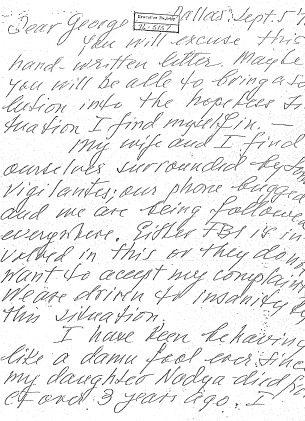
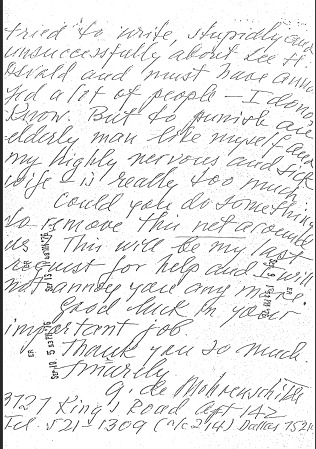
Dear George,
You will excuse this hand-written letter. Maybe you will be able to bring a solution to the hopeless situation I find myself in.
My wife and I find ourselves surrounded by some vigilantes; our phone bugged; and we are being followed everywhere. Either FBI is involved in this or they do not want to accept my complaints. We are driven to insanity by the situation.
I have been behaving like a damn fool ever since my daughter Nadya died from CF [cystic fibrosis] over three years ago. I tried to write, stupidly and unsuccessfully, about Lee H Oswald and must have angered a lot of people I do not know. But to punish an elderly man like myself and my highly nervous and sick wife is really too much.
Could you do something to remove the net around us? This will be my last request for help and I will not annoy you any more.
Good luck in your important job.
Thank you so much.
George de Mohrenschildt[22]
One would assume some very real harassment was going on for him to go to this extent.
As Russ Baker has suggested, when de Mohrenschildt wrote these lines, they weren't random:
De Mohrenschildt clearly saw George H. W. Bush as someone he could trust and who had the power to do something about these problems. He appeared to be suggesting that Bush might actually be familiar with the situation and the basis for the harassment.[23]
On September 28, 1976 Bush responded:
Dear George:
Please forgive the delay in my reply to your September 5th letter. It took time to thoroughly explore the matters you raised.
Let me say first that I know it must have been difficult for you to seek my help in the situation outlined in your letter. I believe I can appreciate your state of mind in view of your daughter's tragic death a few years ago and the current poor state of your wife's health. I was extremely sorry to hear of these circumstances.
In your situation, I can well imagine how the attentions you described in your letter affect both you and your wife. However, my staff has been unable to find any indication of interest in your activities on the part of Federal authorities in recent years. The flurry of interest that attended your testimony before the Warren Commission has long since subsided. I can only suspect that you have become "newsworthy" again in view of the renewed interest in the Kennedy assassination and, thus, may be attracting the attention of people in the media.
I hope this letter has been of some comfort to you, George, although I realize I am unable to answer your question completely. Thank you for your good wishes on my new job. As you can imagine, I'm finding it interesting and challenging.
Very truly yours,
George Bush
Director[24]
One could excuse Bush for hurriedly brushing off de Mohrenschildt, for during that time, as Russ Baker so succinctly put it, Bush was busy working "quietly to reverse the Watergate-era reforms of CIA practices, moving as many operations as possible offshore and beyond any accountability."[25]
And despite Bush's assurances, the letter was of no comfort. As Baker further points out, "For a man who knew what de Mohrenschildt knew, the note must have been terrifying."[26] George was truly on his own now. No help would be forthcoming. From there things continued to get worse.
Parkland Hospital
By the end of October George had tried to commit suicide four times and was voluntarily committed to Parkland Hospital on 11-11-76 until 12-30-76, during which time he received eleven electroshock treatments. Jeanne stated that she delayed this treatment for three weeks but yielded after the doctors told her the next step would be that he would be sent to Terrell State Hospital "where the treatments would be harsher."[27] One can only imagine what would be worse than eleven electroshock treatments.
Jeanne asked George after his first suicide attempt why he did it and he responded, "I was trying to save you, my darling. They are after us. If I am dead, maybe they will leave you alone."[28]
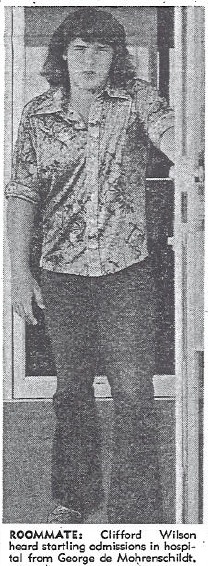
During his time in Parkland, George opened up to his roommate, 17-year-old manual laborer Clifford Wilson. During a subsequent interview with the National Enquirer after George's death, Wilson revealed George spun all sorts of tales real and imagined. George said Oswald could not have killed Kennedy because he and Oswald watched the motorcade, and that when the shots were fired Oswald ran away and he never saw him again. None of this makes sense as George was well documented as being in Haiti during this time. George also said that Oswald was offered money to kill Kennedy by a CIA agent, and that Oswald had turned him down and that Oswald was killed to cover up the initial contact. And that this same agent was now after George and would do him in as well. Though Wilson gave the name of the agent to the periodical, The Enquirer refused to name him because he was "still active in the CIA."[29]
As for George's sudden plunge into madness, one is immediately reminded of the recent House Oversight Committee's revelations as reported by Max Arvo at this site. These concern psychiatrist Louis Jolyon "Jolly" West and his jailed patient Jack Ruby, after which Ruby experienced his own sudden "psychotic break," and was reduced to a babbling incoherent mess, conveniently unable to participate in his own trial hearings.[30] According to records detailed on Wikipedia, Dr. West had previously secured funding for MKULTRA Subproject 43, submitting proposals titled "Psychophysiological Studies of Hypnosis and Suggestibility" and "Studies of Dissociative States." In these documents, West claimed to have developed methods for replacing "true memories" with "false ones" in subjects using deep hypnosis and isolation techniques. Much like George's similar "false memories," with Ruby we see an eerily similar pattern.
Release from Parkland – Jeanne Departs – George is Alone
George was finally released from Parkland on 12-30-76. In late January he returned to his teaching position at Bishop college. In an FBI interview shortly after George's death, Jeanne told investigators George's condition did not improve.[31] Jeanne, a previously successful dress designer for Nardis of Dallas, one of the world's top fashion design houses, was now reduced to selling hats in a local department store. Jeanne was described by an acquaintance as a "gentle, well-spoken, complete lady until about the mid-1960s when she became a victim of alcoholism…"[32] This could be attributed to the enormous pressure she and George were under.
Upon his release from Parkland, George was extremely upset when he found he was now without his Oswald manuscript. Jeanne had one copy of the manuscript secured in the office of de Mohrenschildt's lawyer for his own protection. And so fearful was Jeanne that the only remaining copy would get into the wrong hands, she tossed it out.[33]
The couple had been evicted from their apartment, due to their loud arguments and destructiveness. At one point George broke all the windows. They moved into an apartment on Bishop College campus, and George resumed teaching. Jeanne later told the FBI she was exhausted and needed to rest otherwise she stated she too, would end up in the Parkland Hospital mental ward. Thus, Jeanne temporarily separated from George and went to stay with her brother in California.[34]
George, in his fragile state, all alone in his apartment for the first time in decades, bitterly complained to his few remaining friends of Jeanne's betrayal and abandonment. And Jeanne admitted she carried the guilt over what would happen to him for the rest of her life.
Willem Oltmans & George's Holland Trip
Dutch Journalist Willem Oltmans, characterized in an CIA memo as "an unscrupulous publicity seeker,"[35] landed in Dallas to give a lecture. He checked in with George as he had many times for the past 11 years, several times a year, by his own account, spending many hours filming and taping de Mohrenschildt, all the while sensing a larger story behind the story George told about his relationship with Oswald. "I liked him," said Oltmans, "but then I instinctively knew he was full of shit… but for eleven years I trailed the guy… I always listened to him… I kept working… I waited, I waited. And then damnit, [sic] he dragged me to Bishop College, on the afternoon of the 23rd of February…"[36]
George requested a private meeting at the library as he was afraid their conversation might be overheard.
Oltmans recounted:
When I saw this guy I simply couldn't believe my eyes. From one year to the other he was a totally different person. He was a scared frightened, strange man[…] it was unbelievable." [37] Oltmans had known George to be healthy as a bull. A man who jogged every morning and won tennis matches and was "completely in control of the situation." [38] Oltmans had previously spoken to George's lawyer who told him, "We don't know exactly what happened but suddenly he was crazy."[39]
George indicated to Oltmans that he was ready to make a statement to the media but he wanted to do it in such a way as to not incriminate himself.
Then came the moment Oltmans had waited for – or was it?
I've come to the conclusion that it is impossible to determine George's exact statement because Oltmans offered completely different wording in his testimony to the HSCA, [40] as well as in his book on the assassination,[41] and in an off-the-cuff interview that was reported to the FBI.[42] But the main thrust common to all Oltmans' statements is that George choked up and said that he felt responsible for "Oswald's behavior," and that he had somehow "guided" Oswald to do the terrible deed. And that Oltmans responded to George that this could link him to the assassination of the President. And George said he realized this and that is why he was speaking to Oltmans confidentially, because he trusted him and needed to figure a way out to release this information to the public without incriminating himself.
Oltmans retorted he was puzzled how this could possibly be true. George was in Haiti on the day of the assassination and hadn't been in contact with Oswald for several months. George just laughed in response and replied, Yes."[43]
It should be noted that George still had in mind his newly finished, unpublished manuscript, and what better way to promote it than by making a sensational message in the media. George had flirted with this idea with Oltmans previously during a Dallas visit in 1969, when he had mused, "How would you react if it were revealed one day that I really did organize the Kennedy assassination?"[44] The implication was that George had the power to command all the world's media with the flick of a switch if he so wished, and he was enthralled with that possibility.
According to Oltmans, George was dancing around the subject of his involvement in the assassination because he was frightened. His lawyer had told him that he could go to jail if he said anything like that.[45] Therefore George said if he made a statement, he didn't want to make it in America. He begged Oltmans to get him out of the country because he was being followed and his place was already being searched.
Oltmans immediately got on a payphone with the head of NOS Dutch TV and asked, "What shall I do? He's very nervous, he's off his rocker. But even crazy people have clear moments you know." And his boss responded, "Get the guy to Holland."[46]
Yet over the next several days George continued to be indecisive about leaving and Oltmans was getting fed up. "You have to come out with this truth because otherwise you will go crazy." George blamed his indecisiveness on the medical treatments he received at Parkland. Finally he relented and the two landed in Holland. There he was immediately met with Carel Enkelaar, Programming Head of NOS-TV and Guss Jansen of Strengholt Publishing, the largest publishing house in Holland. It was agreed that the publisher would provide him with a hotel room and a staff for 4-6 weeks to work on the project. He continued to be extremely upset that he didn't have his Oswald manuscript which he would need to refer to in order to complete the project. The only remaining copy was retained by his lawyer in Dallas. The lawyer said Jeanne now retained the rights (most likely as George's power-of-attorney because of his hospitalization). George said, "I have nothing left and I'm going crazy." [47]
A private screening for George was arranged of the recently released film Executive Action. (1973) a fictionalized account of a vast conspiracy surrounding the assassination, during which George took notes. The film's original fact-based screenplay heavily implicated the CIA and was written by Mark Lane and Donald Freed. Freed had even corresponded with George four months before the film's release.[48] Lane disowned the finished product, heavily re-written by Dalton Trumbo, after the end result was a film that implicated everyone but the CIA.[49]
After seeing the film, George "talked in circles, often rambling," as he spun off a newly convoluted conspiracy tale "including Texas oil industrialists, religious right elements, government agencies and Cubans." His new story made no sense to Oltmans or Enkelaar.[50] In the midst of all this, according to Oltmans, George ran into his room and blurted out, "Let's face it. I only made up the story (about Oswald) because everybody makes a million dollars off the Kennedy assassination, and I haven't made anything. So now it's my turn. So now you and I know that."[51] He also stated at another point, "I hope you realize that what we are doing is all one big lie. But let's just play a dirty trick on everyone. It's worth a try."[52] Oltmans was incensed, but remember, this is a man who had just gone through eleven electroshock treatments. Regardless, it was agreed that the following Tuesday a contract would be drawn up between NOS and George. Though insanity was the rule of the day, no one could have predicted what happened next.
Oltmans suggested a change of scenery to calm George's nerves. A day trip to Brussels for lunch was suggested with Oltmans friend, Vladimir Kuznetsov, a Soviet Embassy Cultural Attaché. Once they met in the Hotel Metropole, George spoke briefly to Kuznetsov in Russian, after which he excused himself to go for a short walk before lunch. A walk from which he would never return. George had once again sensed a setup framing him as a Soviet agent. His fears were not unfounded. A later CIA memo described Kuznetsov as "a GRU [Military Intelligence] staff officer."[53]
Unbeknownst to Oltmans, George had been in touch with an old friend of his named Janta (aka Tomasz Janta-Polczynski). Years before, both attended the University of Liege in Brussels. George ran from the Hotel and Janta was waiting to take him in for a few days to clear his head and decide the next direction.[54]
Oltmans suspected George and Janta had planned George's Brussels escape all along. And looking back on it, it's not hard to imagine the George making a frantic private call to his friend as soon as Oltmans told George about the details of the trip and the meeting with the Soviet Attaché.
Once escaped, George and Janta prepared a typed affidavit. It maintained that Oltmans drugged him, tried to get George to admit to things he didn't agree with, and came on to him sexually.[55]
George Escapes back to USA
Several days after hiding out with Janta, George escaped back to the USA and hid out with his daughter, Alexandra at her wealthy aunt's mansion in Manalapan Florida. Under the positive influence of Alexandra, and away from Jeanne's negative influence, he appeared to be recuperating. Nancy Tilton (Alexandra's aunt) indicated he could stay as long as he liked.
Janta then contacted Oltmans telling him that George had departed and requested George's belongings. Oltmans told him to screw himself.
An enraged Oltmans immediately flew to Washington and appeared before the media with a scoop, potentially the mother of all scoops. That George had told him he felt responsible for Oswald's behavior and he and Oswald had discussed the assassination ahead of time. He was soon seated before a confused HSCA panel nervously spouting his sensational tale among a mess of convoluted stories. The committee was all the more determined to find George, who was blissfully unaware of all this, recuperating under the watchful eye of his daughter Alexandra in Florida. Desperate for cash, a $4,000 honorarium offered by Reader's Digest for an exclusive interview proved too tempting. Against Alexandra's wishes, George decided to meet with Journalist Edward J. Epstein who would duly inform him of the hell unleashed against him.[56]
(Next part coming soon.)
_____________
[1] Russ Baker, Family of Secrets (Bloomsbury Press, Kindle Edition 2009) p 102-108
[2] Joan Mellen, Our Man in Haiti: George de Mohrenschildt and the CIA in the Nightmare Republic (Trine Day, 2012) p 74-120
[3] Weiford pp 394-396
[4] Mellen, p 172
[5] Weiford, pp 440-442
[6] George de Mohrenschildt, "I AM A PATSY! I'M A PATSY!' (HSCA Vol XII, March 1979) p 70
[7] George de Mohrenschildt, Lee Harvey Oswald as I Knew Him Edited by Michael A. Rinella (University Press of Kansas, 2014)
[8] George de Mohrenschildt, "I AM A PATSY! I'M A PATSY!' (HSCA Vol XII, March 1979) p 315
[9] Norman Mailer, Oswald's Tale (Random House, 1995)
[10] Norman Mailer, Oswald's Tale,(New York: Random House, 1995) p 458
[11] Greg Poulgrain, The Incubus of Intervention: Conflicting Indonesia Strategies of John F. Kennedy and Allen Dulles (Strategic Information and Research Development Centre, 2015) p 117
[12] Russ Baker, Family of Secrets (Bloomsbury Press, 2009) p 79
[13] Jim Marrs, De Mohrenschildt's Mysterious Doctor, (COVERUPS! Newsletter #22, May 1985) p 1
[14] Jim Marrs, De Mohrenschildt's Mysterious Doctor, (COVERUPS! Newsletter #22, May 1985) p 1
[15] Jim Marrs, De Mohrenschildt's Mysterious Doctor, (COVERUPS! Newsletter #22, May 1985) p1
[16] Jim Marrs, Crossfire: The Plot That Killed Kennedy (Basic Books. Kindle Edition) pp 264-265
[17] FBI interview with Jeanne de Mohrenschildt on 4-17-77 by Special Agents Udo H. Specht & Lloyd B. Harrell Jr.(File# Dallas 89-43) pp 60-67
[18] HSCA Vol XII p 258
[19] Russ Baker, Family of Secrets (Bloomsbury Press, 2009) p 275
[20] Russ Baker, Family of Secrets (Bloomsbury Press, 2009) p 267
[21] Russ Baker, Family of Secrets (Bloomsbury Press, 2009) p 267 / See also: Nancy Wertz Weiford, The Faux Baron, (Lumiere, 2013) pp 605-606
[22] John H. Waller to George Bush, "Draft to George de Mohrenschildt," memorandum, September 22, 1976, 31–33, Box 80T01357A, CIA Document ID No. 32357018, Record Identification Form No. 104-10103-10153, JFK Collection, NARA.
[23] Russ Baker, Family of Secrets (Bloomsbury Press, 2009) p 267 / See also: Nancy Wertz Weiford, The Faux Baron, (Lumiere, 2013) p 269
[24] Waller to Bush, "Draft to George de Mohrenschildt," September 22, 1976, pg 8, RIF No. 104-10103-10153, JFK Collection, NARA. Also: Russ Baker, Family of Secrets (Bloomsbury Press, 2009) p 267 / & Nancy Wertz Weiford, The Faux Baron, (Lumiere, 2013) p 270
[25] Russ Baker, Family of Secrets (Bloomsbury Press, 2009) p 9
[26] Russ Baker, Family of Secrets (Bloomsbury Press, 2009) p 267 / See also: Nancy Wertz Weiford, The Faux Baron, (Lumiere, 2013) p 270
[27] FBI interview with Jeanne de Mohrenschildt on 4-17-77 by Special Agents Udo H. Specht & Lloyd B. Harrell Jr.(File# Dallas 89-43) pp 60-67
[28] Weiford, p 615
[29] Dick Saxty et al, Oswald Could Not Have Killed JFK, (National Enquirer, 4-26-77)
[30] Chad Nagle, MKULTRA Hearing on Capitol Hill Spotlights CIA 'Crimes Against Humanity'(JFK Facts, 7-2-26)
[31] FBI interview with Jeanne de Mohrenschildt, 17 April 1977, FBI File Dallas 89-43, pp. 60–67
[32] FBI Interview of [Blanche] Preston, p. 31, NARA, File KX 89-43.
[33] Nancy Wertz Weiford, The Faux Baron: George de Mohrenschildt (Lumiere, 2013) p 638
[34] FBI interview with Jeanne de Mohrenschildt, 17 April 1977, pp. 60-67
[35] Russell Holmes, "Comments on George de Mohrenschildt," April 4, 1977, p. 5, CIA, NARA, Record No. 104-10414-10144
[36] Transcript of cassette interview with Willem Oltmans by unidentified interviewer [believed to be NBC reporter Tom Pettit], p. 72, FBI Headquarters File 62-109060, Serial 7759 (Dallas Field Office File DL 89-43), Record Group 65, NARA.
[37] Oltmans Interview, FBI HQ File 62-109060, NARA, p.73
[38] Willem L. Oltmans, Reporting on the Kennedy Assassination (University Press of Kansas, 2017) p94
[39] Oltmans Interview, FBI HQ File 62-109060, NARA, p. 71
[40] Testimony of Willem Oltmans, April 1, 1977, House Select Committee on Assassinations (HSCA) p.21
[41] Willem L. Oltmans, Reporting on the Kennedy Assassination (University Press of Kansas, 2017) p.94
[42] Oltmans Interview, FBI HQ File 62-109060, NARA, p. 72
[43] Oltmans Interview, FBI HQ File 62-109060, NARA, p. 72
[44] Willem L. Oltmans, Reporting on the Kennedy Assassination (University Press of Kansas, 2017) p. 47
[45] Oltmans Interview, FBI HQ File 62-109060, NARA, p. 73
[46] Oltmans Interview, FBI HQ File 62-109060, NARA, p. 73
[47] Oltmans Interview, FBI HQ File 62-109060, NARA, p. 75
[48] Nancy Wertz Weiford, The Faux Baron, (Lumiere, 2013) p. 636
[49] Andy Marx, 'Executive Action' dealt with same theme as 'JFK' (Los Angeles Times, 12-29-91)
[50] Nancy Wertz Weiford, The Faux Baron, (Lumiere, 2013) p. 637
[51] Nancy Wertz Weiford, The Faux Baron, (Lumiere, 2013) p 639
[52] Willem L. Oltmans, Reporting on the Kennedy Assassination (University Press of Kansas, 2017) p 100
[53] Russell Holmes, "Comments on George de Mohrenschildt," April 4, 1977, p. 6, CIA, NARA, Record No. 104-10414-10144
[54] Nancy Wertz Weiford, The Faux Baron, (Lumiere, 2013) p 643
[55] Affidavit prepared in Brussels, Belgium by George de Mohrenschildt, March 11, 1977, NARA #180-10105-10250. See Also: Willem L. Oltmans, Reporting on the Kennedy Assassination (University Press of Kansas, 2017) pp. 256-257
[56] Nancy Wertz Weiford, The Faux Baron, (Lumiere, 2013) pp. 649-652


